


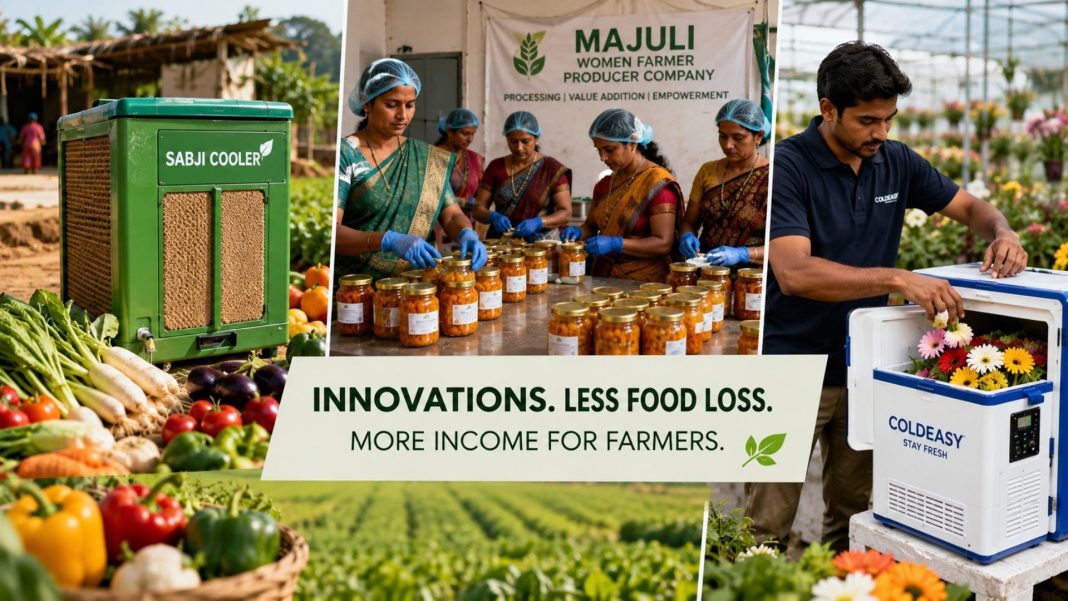

Innovations to Reduce Food Loss: According to media reports citing data from the Food and Agriculture Organization (FAO), nearly 40% of the vegetables, fruits, and flowers produced annually in India spoil before reaching consumers.
A primary contributor to this massive post-harvest loss is the acute shortage of decentralized cold storage infrastructure. This gap reportedly causes an annual economic loss of approximately ₹1.5 lakh crore to the agricultural sector.
To address this challenge, young entrepreneurs and grassroot innovators across India are introducing cost-effective, decentralized innovations aimed at extending produce shelf life, enabling value addition, and safeguarding farmers’ incomes.
1.Electricity-Free ‘Sabji Cooler’ Keeps Vegetables Fresh in Solapur
Innovations to Reduce Food Loss: In Solapur, Maharashtra, startup Routkart has developed an eco-friendly storage innovation called the “Sabji Cooler” (portable vegetable cooler).
According to media reports, the device functions entirely without electricity, relying instead on the fundamental principles of evaporative cooling.
Sarayu Kulkarni, co-founder of Routkart, stated in media reports that the cooling unit requires minimal water to operate.
The evaporative process helps maintain ambient coolness and humidity inside the chamber, keeping green vegetables, mushrooms, fruits, and flowers fresh for 5 to 7 days.
By preserving the original color, aroma, and moisture content of perishable produce, the portable innovation allows small-scale street vendors and rural farmers to avoid distress sales at low prices.
2.Value Addition Turns Wild Fruits into Profit in Majuli
Innovations to Reduce Food Loss: In Majuli, Assam recognized as the world’s largest river island local farmers historically struggled to receive fair market prices for their harvests due to logistical barriers and geographic isolation.
Undeterred by these challenges, local women established the Majuli Women Farmer Producer Company and installed local food processing units.
According to media reports, the enterprise began processing locally grown mustard, rice, and wild forest fruits into market-ready goods.
Uncultivated produce like Elephant Apple (outenga), which was previously discarded or wasted due to lack of local demand, is now processed into pickles, preserves, and value-added items.
This processing initiative has provided a steady secondary revenue stream for female agricultural workers in the region.
3.’Coldeasy Box’ Extends Produce Shelf Life in Hyderabad
In Hyderabad, Telangana, innovator Vishal Singhal developed a compact cold storage solution known as the “Coldeasy Box”. Designed to cater to local vendors, small farmers, and florists, the unit effectively doubles the shelf life of fresh produce, fruits, and flowers.
According to media reports, the portable cold box operates on low-power, energy-efficient cooling mechanisms that keep sensitive produce fresh overnight and over extended periods.
Local florists and vegetable vendors report that using the storage box helps them sell stock the following day without loss of quality or appearance.
The innovation has proven particularly effective in mitigating post-harvest losses for highly perishable crops such as tomatoes, bananas, and delicate seasonal flowers.
A Micro-Level Shift Towards Sustainable Agriculture
While large-scale industrial cold chains require significant capital investments, these grassroots innovations provide accessible, low-cost alternatives tailored to smallholders.
By lowering post-harvest losses at the farm gate and retail levels, such decentralized solutions are actively helping stabilize produce prices, reduce food waste, and improve rural livelihoods across the country.
Also Read: NEET Aspirant Dies by Suicide in Maharashtra After Falling Short in Re-Exam