


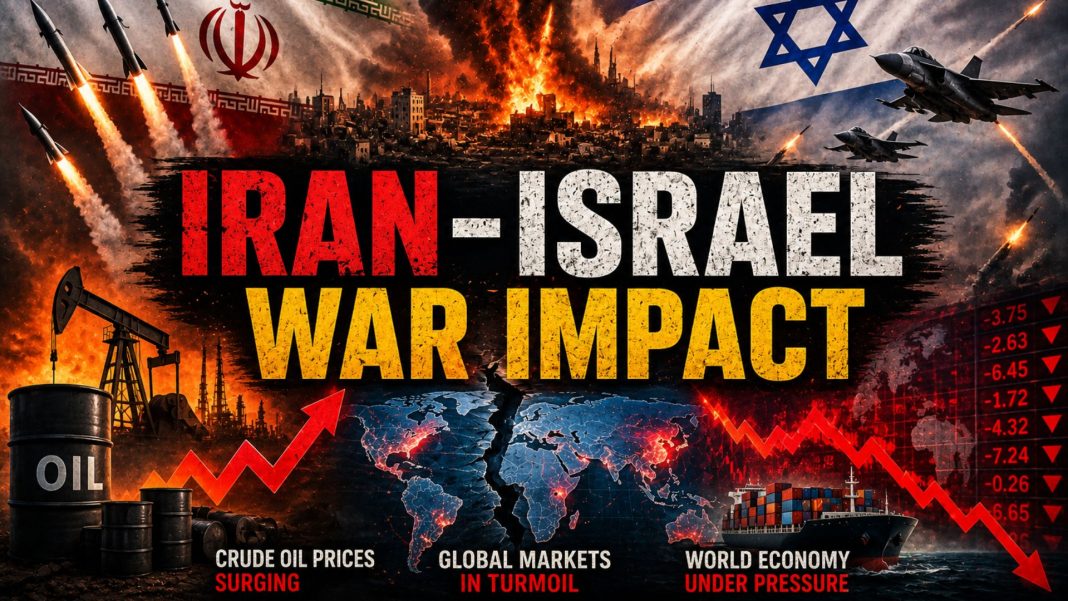

Iran-Israel War Impact 2026: The economic impact of this Middle East crisis has now spread rapidly across interconnected global trade networks. According to reports from ground zero, dozens of cargo ships are stranded at critical maritime choke points. The direct impact of this is already visible at fuel pumps in major importing nations, including India, through changing fuel prices and supply chain pressures.
International market experts have made it clear that this conflict is no longer just a regional security issue, it has gripped the global economy. The blockade of energy supplies and major trade routes has triggered a dangerous domino effect. Amid continuously disrupted global supply chains and record-breaking inflation, the entire world now faces a direct threat of a major economic recession.
The Core Powerhouses: Why This Specific Conflict Strangled Global Trade
Iran-Israel War Impact 2026: The entire crisis began because the two warring nations hold absolute monopoly over two of the most critical foundations of the modern world economy: energy transport and technology.
Iran’s Energy Monopoly: Iran controls the Strait of Hormuz, a narrow maritime highway through which 20% of the world’s petroleum and global Liquefied Natural Gas (LNG) flow daily. Iran itself contributes 3.5 million barrels of oil per day to the global market, meaning any conflict here instantly chokes the world’s primary energy vein.
Israel’s Tech Monopoly: On the other side of the battlefield sits Israel, the Silicon Valley of the Middle East, which dominates global microchip research, cybersecurity, and artificial intelligence. Because Iran threatens this tech hub while holding the keys to the Strait of Hormuz, the outbreak of war immediately triggered a twin panic: a fear of a global technology freeze combined with an overnight shutdown of energy shipping routes.
Oil on Fire: How the Shipping Blockade Exploded Energy Prices
Iran-Israel War Impact 2026: Because the Strait of Hormuz became an active war zone, international shipping companies immediately halted their tankers, creating an instant, artificial scarcity that sent energy markets into absolute chaos.
The $120 Crude Spike: With tankers stuck and unable to pass through the conflict zone, Brent Crude oil prices violently rocketed past $120 per barrel within days as countries scrambled to outbid each other for the remaining available oil.
The 1 Billion Barrel Deficit: This sudden halting of ships and the forced shutdown of regional oil fields quickly added up, leading energy analysts to project a staggering total loss of 1 billion barrels of oil production from the global supply chain.
The LNG Explosion (+140%): As a direct result of this oil deficit, countries rushed to secure alternative power sources like Liquefied Natural Gas (LNG). This frantic pivoting caused global LNG spot prices to explode by over 140%, instantly making electricity and industrial heating unaffordable worldwide.
The Global Shockwave: How Surging Energy Costs Broke International Supply Chains
Once energy prices skyrocketed, the shockwave rolled out of the oil markets and smashed directly into global trade, manufacturing, and transportation networks.
The $194 Billion Arab GDP Drain: Because regional trade lanes were blocked and local infrastructure was damaged by the skyrocketing costs of doing business, a United Nations (UNDP) study revealed that Arab nations stand to lose between $120 billion to $194 billion in collective GDP growth.
The GCC Food Crisis: This regional economic breakdown immediately threatened survival basics; since Gulf countries import 80% of their food through the blocked Strait of Hormuz, supermarkets were forced to switch to expensive air-freight, causing local food prices to spike by 40% to 120%.
The Global Airspace Shutdown: Simultaneously, because the airspace above the Gulf became a missile hazard, commercial airlines were forced to completely reroute flights around the Middle East. This longer path doubled jet fuel consumption, which, fueled by the already high oil prices, triggered an immediate explosion in global airfares and air-cargo costs.
European Stagflation: Consequently, hit by both massive air-cargo costs and the 140% LNG hike, European factories began shutting down. This forced the European Central Bank (ECB) to halt interest rate cuts, trapping the continent in stagflation (low economic growth mixed with painfully high inflation).
The Indian Impact: How Global Inflation Strained India’s Economy
As Europe stumbled and global fuel costs surged, the crisis travelled directly to India, a nation highly vulnerable because it imports 80% of its crude oil and 65% of its LPG, mostly from the Middle East.
The Inflation and Currency Punch: Because India is so dependent on this imported oil, the $120 price spike instantly leaked into the domestic market. Every $10 rise in oil added 0.25% to India’s inflation, causing the Indian Rupee to weaken heavily against the US Dollar and expanding the nation’s trade deficit.
The MSME and LPG Squeeze: Due to this widening deficit and shrinking global gas supplies, the Indian government had to ration commercial LPG allocations. This fuel shortage directly crippled over 15,000 Micro, Small, and Medium Enterprises (MSMEs) that rely on gas for daily manufacturing.
Hospitality and Agriculture Stress: Following the MSME slowdown, urban restaurant chains began facing supply crunches from rising commercial fuel costs, while domestic fertilizer plants (which rely heavily on imported Middle Eastern chemicals) had to cut production, directly threatening upcoming agricultural crop cycles.
The Diaspora and Remittance Anxiety: To make matters worse, the domestic economic strain was compounded by panic from abroad. The war put the jobs of 10 million Indian workers in the Gulf at risk, threatening the record $135 billion in annual remittances that India relies on to keep its foreign exchange reserves healthy.
The Survival Strategy: How India’s Countermeasures Broke the Chain Reaction
To prevent these connected domestic crises from triggering a total economic collapse, India used swift diplomatic and strategic maneuvers to break the chain of dependency on the war zone.
The Diplomatic Masterstroke: First, India leveraged its neutral geopolitical stance to negotiate directly with Tehran. This successfully ensured that ships flying the Indian flag, or heading directly to Indian ports, were granted safe, uninterrupted passage through the otherwise blocked Strait of Hormuz.
Operation Sankalp: To back up this diplomatic win with hard security, the Indian Navy immediately deployed warships under Operation Sankalp, escorting vital energy cargo vessels safely past the conflict zone to prevent any sudden domestic fuel shortages.
Strategic Reserves and Pivoting: Finally, to completely bypass the volatile Middle Eastern market, India tapped into its underground Strategic Petroleum Reserves to stabilize local prices, while Indian refiners aggressively shifted their buying patterns to import cheaper, safer crude oil from Russia, West Africa, and the United States.