


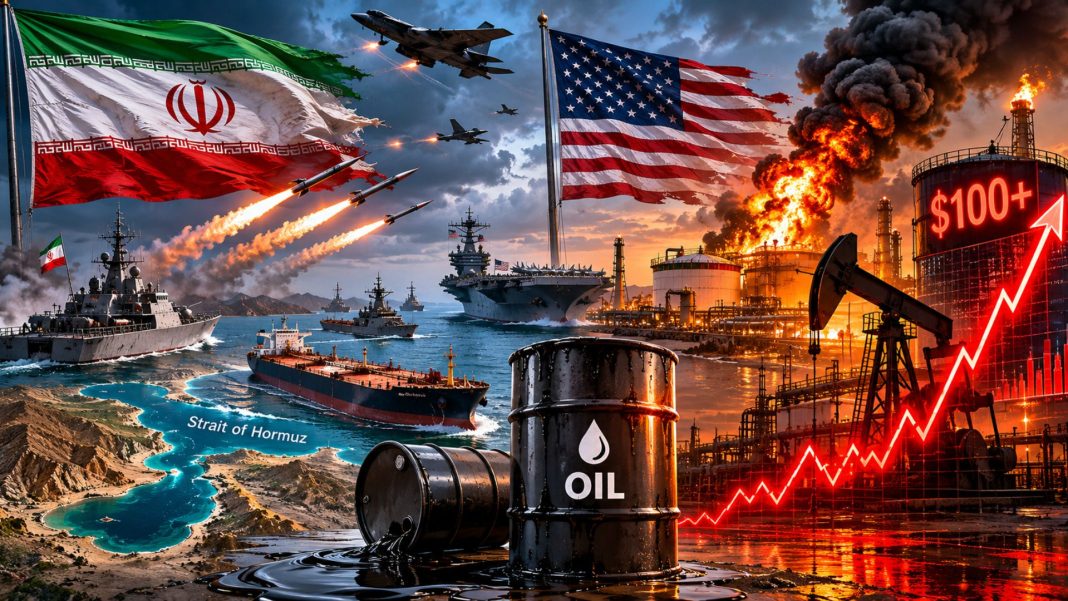

Iran-US Tension: To put it simply, a temporary seven-week ceasefire between the United States and Iran has suddenly collapsed. The situation turned critical on Monday when US Central Command (CENTCOM) launched unexpected airstrikes in southern Iran’s Hormozgan province, near the strategic Strait of Hormuz. The US claimed it acted in self-defense, targeting Iranian boats that were attempting to lay naval mines, and destroying nearby missile sites.
Iran completely rejected this justification, calling the attack a blatant violation of the ceasefire. Tehran also claimed that its air defense systems successfully shot down an American drone that entered its airspace.
In short, these fresh clashes have completely derailed the ongoing peace talks, pushing both nations back to the brink of open war and threatening to spark a massive spike in global crude oil prices.
The Inside Story: Has Trust in Washington Evaporated?
Iran-US Tension: This military confrontation has dealt a severe blow to peace efforts in West Asia. The direct clash near the strategically vital Strait of Hormuz has caused regional tensions to spiral out of control.
Iran’s Foreign Ministry strongly condemned the action, accusing the US of violating the truce with unprovoked aggression. Iranian officials stated that after this incident, it is impossible to trust Washington anymore, which could permanently derail any future diplomatic negotiations.
The Military Standoff: Preemptive Defense vs. Iranian Retaliation
Over the last 48 hours, the military standoff between the two major powers has intensified rapidly:
The US Position: US Central Command (CENTCOM) confirmed the airstrikes but maintained that the operation was purely defensive, aimed at securing the world’s most critical maritime oil route.
The Iranian Response: Iran’s Islamic Revolutionary Guard Corps (IRGC) countered by stating that American aircraft violated their territorial sovereignty. They claimed to have successfully shot down a US drone and driven away a fighter jet.
A senior Iranian military spokesperson issued a stark warning, declaring that if the US or Israel launches another attack, Iran will unleash a much harsher and wider response that will be felt far beyond the Middle East.
The $24 Billion Stumbling Block: Peace Talks Face a Major Roadblock
Iran-US Tension: This military flare-up happened at a highly sensitive time when back-channel diplomacy was actively taking place. US Secretary of State Antony Blinken had previously indicated that a 30-day transitional framework was being prepared to cool down regional tensions and safely reopen shipping routes, while delaying complex issues like Iran’s nuclear program for later.
However, a massive financial dispute has emerged as the main obstacle. According to Iranian media reports, Tehran is strictly demanding the immediate release of $24 billion in frozen Iranian assets as a condition for signing the agreement. This financial deadlock remains unresolved and has become even more complicated following the recent strikes.
Global Economic Fallout: Crude Oil Flirts with the $100 Mark
The Strait of Hormuz is the world’s most important energy corridor, carrying one-fifth of the global supply of oil and liquefied natural gas (LNG). This is why the rising tension has sent panic through the international energy market.
Immediately after the US airstrikes, fears of supply disruptions caused oil prices to jump by nearly 4 percent, pushing Brent Crude dangerously close to $100 per barrel.
While there was a slight correction on Wednesday as investors cautiously assessed the situation, Brent Crude dropped $1.42 to $98.16 per barrel, and US WTI Crude fell $1.66 to $92.23 per barrel, the market remains highly volatile. Shipping traffic through the strait is currently reported to be far below normal levels.
Domestic Realities: Internet Partially Restored Inside Iran After 90 Days
Amidst this heavy geopolitical tension, there is a notable domestic update from inside Iran. Internet monitoring group NetBlocks and Iranian Vice President Mohammad Reza Aref confirmed that the government has taken the first steps to partially restore internet connectivity across the country. This ends a grueling 90-day digital blackout imposed during the height of the conflict.
However, this internal relaxation does not mean Iran is softening its foreign policy. Iran’s Supreme Leader Ayatollah Mojtaba Khamenei made it clear that anti-US and anti-Israel stances will remain the core identity of the Islamic Republic.
On the other side, US President Donald Trump remains firm on his stance that Washington’s primary objective is to permanently prevent Iran from developing nuclear weapons.
With diplomatic options shrinking, oil prices fluctuating, and a dark cloud of uncertainty over the Strait of Hormuz, West Asia is once again heading toward a major economic and military crisis.
Also Read : India-US Bilateral Agreement : Securing Rare Earth Supply Chains to Break China’s Monopoly