


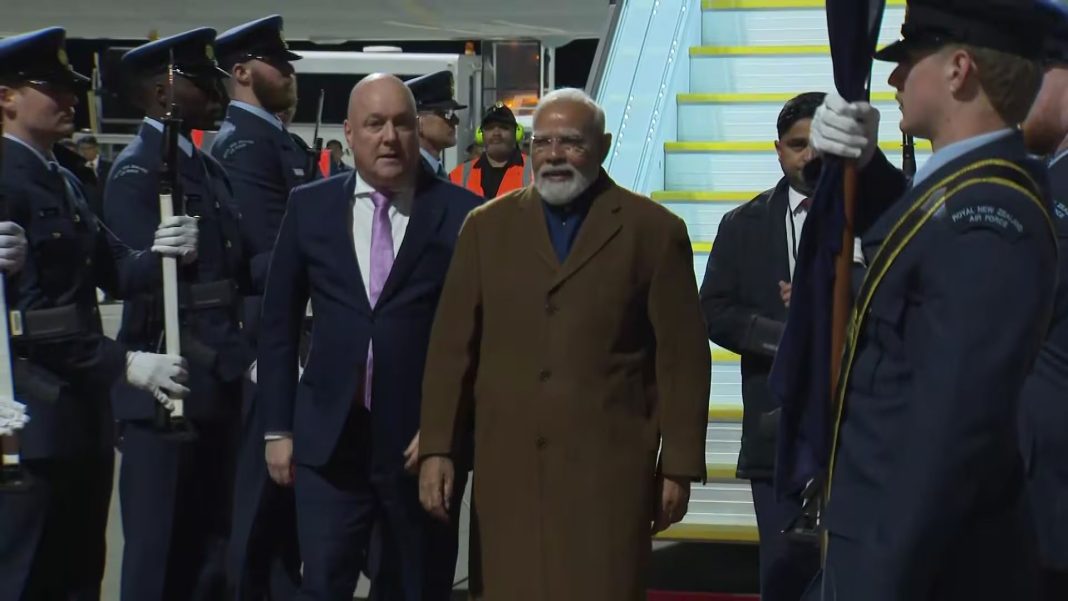

Modi’s Historic Landing: Breaking a four-decade diplomatic dry spell, Indian Prime Minister Narendra Modi touched down in New Zealand on Friday for the final, high-stakes leg of his three-nation tour.
The significance of the moment was clear right from the tarmac. New Zealand Prime Minister Christopher Luxon personally welcomed Modi at the Auckland airport, signaling the weight Wellington is placing on this rare visit. Not since Rajiv Gandhi in 1986 has a sitting Indian prime minister traveled to the island nation.
Taking to social media shortly after his arrival, Modi shared photos of the warm reception and boldly labeled the upcoming days as “historic.”
“This visit is historic, being the first Prime Ministerial visit to New Zealand in four decades. I look forward to holding talks with Prime Minister Luxon and discussing the complete range of the India-NZ friendship,” Modi stated.
The Indian Prime Minister also announced he would connect directly with the local diaspora, adding, “I will also be addressing a community programme tomorrow in Auckland.”
The Billion-Dollar Handshake: Inside the Brand New FTA
Modi’s Historic Landing: Tariffs crumble as a fresh Free Trade Agreement opens up massive economic corridors between New Delhi and Wellington.
Modi’s arrival isn’t just about diplomatic pleasantries; it comes hot on the heels of a massive economic breakthrough. Weeks before the trip, India and New Zealand officially signed a landmark Free Trade Agreement (FTA) that promises to aggressively reshape bilateral commerce.
The agreement is a major win for Indian exporters, completely eliminating duties on 100 percent of Indian goods entering New Zealand. In return, New Zealand has secured tariff-free market access to 70 percent of India’s massive consumer market.
Economic analysts expect the FTA to spark immediate growth across multiple industries:
For India: Instant boosts to textiles, pharmaceuticals, and IT services, which can now enter New Zealand completely tax-free.
For New Zealand: Unprecedented access for its premium dairy, meat, and agricultural technology into one of the world’s fastest-growing economies.
Power Vacuum in the Pacific: Rising Above the Trump Retreat
Modi’s Historic Landing: As Washington steps back from regional security, New Delhi and Wellington are stepping up to counter China’s growing shadow.
Beyond the balance sheets, the geopolitical backdrop of this meeting is intensely complex. Modi’s visit comes at a critical juncture for the Indo-Pacific.
With US President Donald Trump pivoting away from traditional security theaters, the region’s “middle powers” are realizing they can no longer rely solely on a Washington safety net.
As the United States retreats into a more isolationist posture, regional heavyweights like India, Australia, and New Zealand are converging to handle a rising and assertive China on their own terms.
Beijing has actively been trying to woo smaller Pacific island nations to expand its military and economic footprint, a move that has deeply rattled both Canberra and Wellington.
Just hours before Modi landed, New Zealand made a quiet but powerful defensive move, announcing it would explore joining the existing Australia-Fiji mutual defense agreement. The pact is widely understood to be a collective strategy to check China’s ambitions in the South Pacific.
The Three-Nation Blueprint: Modi’s Regional Sweeps
From Jakarta to Canberra, and now Auckland, India is assembling a formidable strategic puzzle.
New Zealand marks the final stop of a rapid-fire, three-nation diplomatic tour that has seen Modi strengthen ties across the Indo-Pacific.
The journey began in Indonesia, where discussions centered on vital maritime security and protecting crucial shipping lanes. From there, Modi traveled to Australia, where he and Australian Prime Minister Anthony Albanese declared a major expansion in military cooperation.
The two leaders pledged to significantly enhance their security partnership, boosting military interoperability through expanded aircraft deployments in each other’s territories, closer personnel ties, and deeper information-sharing networks.
Now, in Auckland, Modi looks to lock in the final piece of this strategic puzzle, ensuring that India’s economic and security alliances are firmly anchored across the entire region.
Also Read : Donald Trump Iran Assassination Plot: Israel Warns US of New Threat, Reports Claim