



Inside the Oval Office: Just weeks after the world breathed a sigh of relief over a historic Memorandum of Understanding (MoU) signed in Versailles, West Asia has slid back into a high-stakes military conflict. The fragile truce, which was supposed to hold the line and prevent an all-out regional war, is officially dead.
On Wednesday, US President Donald Trump sent shockwaves through international diplomatic circles by bluntly declaring that the ceasefire and the preliminary peace agreements with Iran are completely “over.” What was meant to be a 60-day window to negotiate a permanent nuclear deal and secure international waters has instead mutated into a rapid exchange of drone strikes, cruise missiles, and heavy economic sanctions.
While international mediators from Qatar to Pakistan are working the phones in a desperate bid to prevent total escalation, the reality on the ground paints a grim picture: the shadow war between Washington and Tehran has once again turned white-hot.
Inside the Oval Office: The Dramatic Monday Meeting That Changed Everything
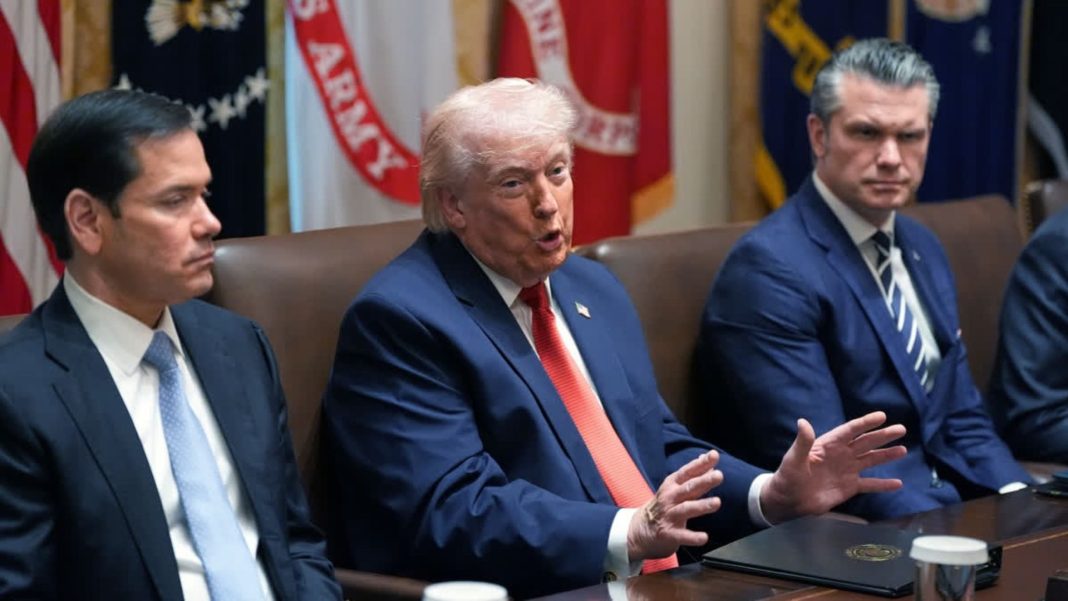
Inside the Oval Office: To understand how a historic peace agreement unraveled in a matter of hours, one has to look inside the four walls of the Oval Office on Monday evening. President Trump was packed and prepared to leave the White House for Ankara, Turkey, to attend a crucial NATO summit. The mood was urgent, but the diplomatic track with Iran was still technically alive.
That was until Secretary of State Marco Rubio and Defense Secretary Pete Hegseth abruptly entered the room.
According to intelligence briefings later verified by reports, Rubio and Hegseth carried highly sensitive, real-time data showing that Iranian forces had launched a series of unprovoked attacks in the Strait of Hormuz, the world’s most critical chokepoint for oil and gas transit.
The Attack in the Strait
The intelligence revealed that Iran had targeted commercial vessels navigating the southern route of the Strait using:
Anti-ship cruise missiles
One-way “kamikaze” attack drones
The assessment confirmed that three massive commercial vessels, including a high-value Liquefied Natural Gas (LNG) tanker, had sustained significant damage.
For Trump, this was the ultimate betrayal of the Versailles agreement. Standing in the Oval Office, he reportedly turned to his top advisors and asked point-blank if Tehran had ever been negotiating in good faith. The consensus among his inner circle was unanimous
they were not. Before boarding the plane to Turkey, the President’s mindset had completely shifted from diplomacy to retaliation.
“They Are Liars”: Trump’s Scorched-Earth Response from Ankara
Inside the Oval Office: By the time Air Force One touched down in the Turkish capital, the American diplomatic machinery had already begun dismantling the two-week-old MoU. Trump did not mince words when journalists questioned him about the status of the truce.
“As far as I’m concerned, it’s over,” Trump announced to reporters, signaling a total return to his maximum pressure campaign.
The President expressed deep fury, particularly over the timing of the maritime attacks. The US administration had intentionally allowed the high-profile funeral of Iran’s late Supreme Leader, Ayatollah Ali Khamenei, to proceed smoothly in the holy city of Mashhad without military interference as a gesture of goodwill. To have commercial ships attacked at the exact same time was seen by the White House as a slap in the face.
“These are liars. We make an agreement, they go out, they talk to the press and say we never talked about this. There is something wrong with them. They are crazy. They are lowlifes, they are sick people, led by sick people, and they are cruel, violent people.”
— President Donald Trump in Ankara
The Intelligence Wildcard: Israel Exposes a New Assassination Plot
While the missile strikes in the Strait of Hormuz acted as the immediate trigger for military action, a deeper, more sinister security threat was unfolding in the background. Days before the ceasefire collapsed, Israeli intelligence agencies shared a highly specific, urgent dossier with their American counterparts.
The intelligence alleged that Iran’s covert operations wing was actively planning a fresh, targeted plot to assassinate Donald Trump on American soil.
A Targeted Threat
While US intelligence agencies had been tracking generic “chatter” and ongoing threats from Tehran for weeks, sources confirm that the newly shared Israeli data was uniquely dangerous because it contained specific, actionable timelines and operational details regarding the conspiracy.
Trump himself addressed these threats publicly on Wednesday, acknowledging that he remains Iran’s “Number 1 target.”
The “Cancer” Analogy: Speaking to reporters, Trump noted that he had seen updated security briefings confirming he was at the top of every Iranian target list. “They want to take out the American leader, me,” Trump said. “We have to eradicate this cancer. You know what you do? You kill the cancer at the very beginning. And that’s my opinion.”
While national security officials have not explicitly stated that this assassination plot was the official reason for tearing up the Versailles treaty, the timing of the intelligence drop directly aligned with Trump’s decision to launch a counter-offensive.
Operation Maximum Retaliation: US Central Command Strikes Back
The American military response to the shipping attacks was instantaneous, massive, and highly coordinated. Over a grueling 48-hour window, US Central Command (CENTCOM) unleashed a relentless wave of airstrikes targeting Iranian military infrastructure.
On Tuesday, CENTCOM confirmed precision strikes hitting 80 distinct military targets inside Iran, focusing heavily on coastal missile batteries and drone launch pads. The escalation intensified on Wednesday when a secondary wave hit an additional 90 targets, successfully crippling logistical hubs and command structures.
According to Iranian state media, these attacks resulted in at least 14 casualties. Heavy fires broke out at an Islamic Revolutionary Guard Corps (IRGC) barracks in Bushehr, and severe power outages hit the strategic port city of Chabahar.
Iranian officials also complained that critical infrastructure civilian networks were caught in the crossfire. The key bridge and railway line connecting the national transport grid to the city of Mashhad, where millions had gathered for the Supreme Leader’s funeral ceremonies, sustained structural damage. Furthermore, social media footage verified that a maritime traffic control tower in Chabahar had been partially destroyed.
Tehran’s Counter-Punch: US Regional Bases Under Fire
Iran did not take the American bombardment lying down. Adhering to their doctrine of asymmetric retaliation, the IRGC and its regional affiliates immediately launched coordinated strikes against US military installations scattered across neighboring Gulf countries.
By Thursday evening, Iranian state media proudly broadcasted successful strikes against American assets in Kuwait, Bahrain, Qatar, Jordan, and Iraq.
Mohammad Baqer Qalibaf, the hardline Speaker of the Iranian Parliament, took to social media platform X to issue a stern warning to Washington. He emphasized that the era of unilateral American action without consequence was officially over, stating that if the US hits, they will get hit back. He added a biting caveat that the critical Strait of Hormuz would now only open under explicit Iranian terms, completely immune to American threats.
The Blame Game: Who Broke the Versailles Pact?
As the region edges closer to a full-scale conventional war, both Washington and Tehran are working overtime to control the global narrative, with each pointing the finger at the other for breaking the 14-point peace pact signed on February 28.
The American Stance: “Iran Chose Violence”
US officials maintain that the Trump administration did everything possible to prioritize diplomacy, but that Iran’s revisionist maritime behavior made peace impossible.
An anonymous US official told reporters that President Trump’s first priority has always been peace and diplomacy, but unfortunately, Iran chose the path of violence and must now suffer the consequences.
The official emphasized that the United States will not sit idly by while Iran carries out international acts of terrorism, and that the administration will never allow Iran to possess a nuclear weapon.
The Iranian Defense: “Washington Violated the Route”
Conversely, Iranian diplomats argue that it was actually the US that secretly sabotaged the Versailles treaty. Speaking to the Wall Street Journal, a senior Iranian diplomat alleged that Washington began unilaterally rerouting heavy maritime traffic through the Strait of Hormuz without consulting or coordinating with Tehran. According to Iran’s interpretation of the dynamic maritime rules under the MoU, this uncoordinated movement constituted a direct breach of sovereignty, thereby legally justifying their subsequent drone and missile responses against those commercial vessels.
Crisis Diplomacy: Can Regional Backchannels Stop a Full-Scale War?
Despite the fiery public rhetoric and the smoke rising from military bases across the Gulf, the international community has not given up hope. A frantic, multi-nation diplomatic rescue operation is currently taking place completely behind closed doors.
According to insider reports, top diplomats and intelligence chiefs from five key regional brokers, Qatar, Pakistan, Turkey, Egypt, and Saudi Arabia, have formed an emergency communications network.
Throughout Wednesday and Thursday, these officials placed dozens of urgent phone calls to both Washington and Tehran, pleading with both leadership groups to freeze military movements before the conflict reaches a point of no return.
White House insiders have quietly confirmed that despite President Trump’s incredibly harsh public statements, low-profile, “backchannel” communication lines remain open.
The goal of these underground talks is simple: establish a temporary tactical pause on missile strikes so that a new framework for a ceasefire can be brought to the table. However, with both nations actively trading fire and national pride at stake, the window for a diplomatic resolution is closing fast.
A Fragile Region on the Brink
The complete collapse of the February truce has effectively reset the geopolitical clock in West Asia to its most volatile state in recent memory. The 14-point agreement was supposed to be a bridge to stability; instead, it has become a blueprint for betrayal.
As oil markets react nervously to the instability in the Strait of Hormuz and military forces throughout the Gulf remain on high alert, the world watches to see who will take the next step.
Will the backchannel diplomacy led by Qatar and Pakistan successfully cool down the rhetoric, or will the personal animosity, assassination plots, and strategic mistrust push the United States and Iran into a catastrophic regional war? For now, the weapons are doing the talking.
Also Read : Donald Trump Iran Assassination Plot: Israel Warns US of New Threat, Reports Claim