


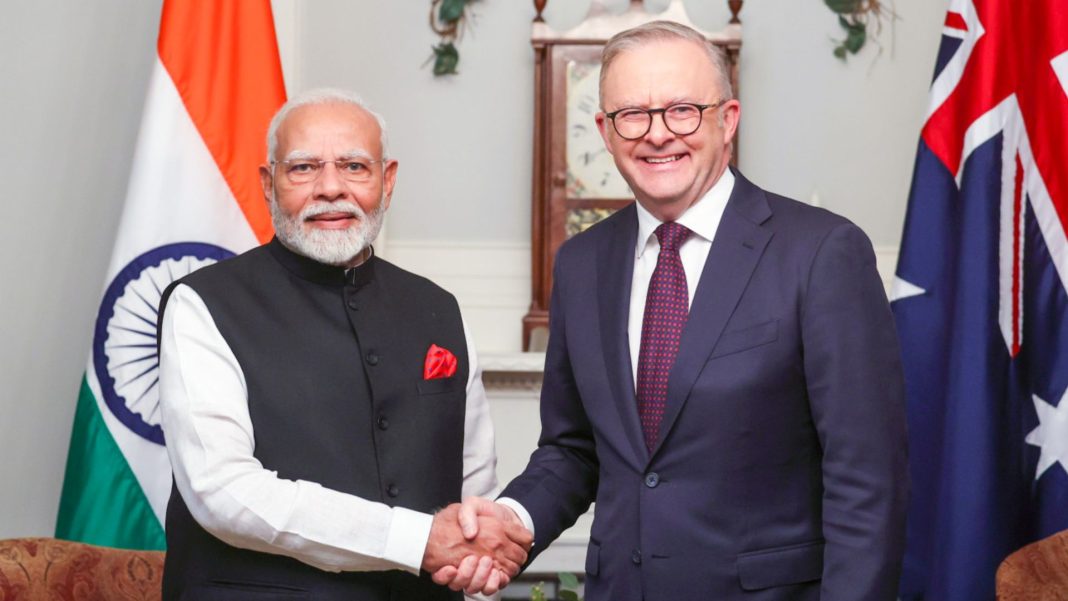

Oceans of Trust: In a major diplomatic move that reshapes the geopolitical landscape of the Indo-Pacific, Indian Prime Minister Narendra Modi and Australian Prime Minister Anthony Albanese have unveiled a sweeping Joint Declaration on Defense and Security Cooperation. The landmark agreement signals a massive upgrade in bilateral ties, focusing heavily on deep military integration, advanced technology sharing, and maritime security.
The high-stakes meeting comes at a critical juncture for the region. As traditional geopolitical alliances face uncertainty, New Delhi and Canberra are stepping up to anchor the Indo-Pacific, asserting their roles as the twin pillars of regional stability.
Beyond the Blue Horizon: The New Maritime Blueprint
Oceans of Trust: For decades, the Indian and Pacific Oceans were viewed as distinct geopolitical zones. Today, India and Australia have officially declared them inseparable. Speaking at a joint press briefing, Prime Minister Modi reframed the geography of the region altogether.
The Indo-Pacific is not just a meeting point of two oceans. It represents the shared aspirations of like-minded democracies such as India and Australia. At the heart of this shared vision is a robust focus on maritime domain awareness and industrial collaboration.
Instead of just conducting joint exercises, the two nations are moving toward a fully integrated naval ecosystem.
The Shipbuilding Partnership
A standout feature of the new declaration is a comprehensive pact on shipbuilding, repair, and maintenance. Under this framework:
Logistical Hubs: Australian naval vessels will gain streamlined access to Indian shipyards for repair and maintenance, significantly extending Canberra’s operational reach into the Indian Ocean.
Industrial Synergy: Indian defense shipyards will collaborate directly with Australian shipbuilders to co-develop maritime platforms, creating a resilient supply chain independent of single-source vulnerabilities.
Commercial Spillovers: The partnership is expected to boost commercial maritime manufacturing, benefiting commercial ports and shipping lines in both nations.
Planes, Bases, and Boot Camps: Military Interoperability Gets a Turbocharge
Oceans of Trust: The term “interoperability” is frequently tossed around in diplomatic circles, but the new India-Australia declaration injects it with real muscle. The two leaders pledged to elevate their military-to-military relationship from simple coordination to seamless operational integration.
Expanded Air Deployments
In one of the most significant operational upgrades, India and Australia will expand military aircraft deployments into each other’s territories. This means Indian maritime surveillance aircraft will routinely operate out of northern Australian bases like Darwin, while Australian assets will utilize Indian bases, such as the strategic Andaman and Nicobar Islands. This cross-deployment creates a continuous, unbroken web of surveillance across critical maritime chokepoints.
The Innovation Corridor
To fuel this military evolution, the leaders launched the India-Australia Defense Innovation Corridor. This initiative is specifically designed to connect defense startups, venture capital, and established tech industries in both countries. By pooling intellectual and financial resources, the corridor aims to fast-track the development of next-generation defense hardware, from autonomous underwater vehicles to advanced drone technology.
The China Factor: Guarding the Rulebook in Changing Times
While neither leader explicitly named Beijing in their public addresses, the shadow of China’s growing assertiveness loomed large over the summit. The context of this meeting is unique: Washington’s current foreign policy posture under President Donald Trump has seen a partial retrenchment from traditional theater dynamics, inadvertently giving Beijing more room to flex its muscles.
In response, Modi and Albanese drew a firm line in the sand, insisting that the Indo-Pacific must be governed by international law rather than raw military might.
The UNCLOS Anchor
The joint declaration repeatedly emphasized adherence to the 1982 United Nations Convention on the Law of the Sea (UNCLOS). By explicitly backing UNCLOS, India and Australia sent a clear message regarding contested waters like the South China Sea:
Sovereignty Matters: Boundaries and territorial integrity must be respected, and disputes must be resolved legally, not through coercion.
Freedom of Navigation: Global trade depends on open sea lanes. Both nations committed to actively patrolling and keeping these channels free for international overflight and shipping.
Silicon and Steel: Harnessing Cyber and Emerging Tech
Modern warfare and economic dominance are no longer fought just with steel and gunpowder; they are fought in the digital realm. Recognizing this, Modi and Albanese placed critical and emerging technologies at the absolute center of their strategic map.
The partnership will find its teeth through the Australia-India Partnership on Cyber, Critical Technologies and Supply Chains (Australia-India PACTS). Cooperation will focus on three core pillars:
Cyber Security: Real-time sharing of threat intelligence to shield critical infrastructure from state-sponsored hacks.
Critical Minerals: Securing lithium, cobalt, and rare earth supply chains essential for defense tech and clean energy.
Strategic Tech: Joint research into Artificial Intelligence (AI), quantum computing, and secure 5G/6G communication networks.
By aligning their tech sectors, both nations hope to build a reliable democratic alternative to the tech supply chains currently dominated by authoritarian regimes.
The Quad Shifts Gears: From Geopolitics to Humanitarian Action
Interestingly, the Quadrilateral Security Dialogue (the Quad), comprising India, Australia, Japan, and the United States, received only passing mentions during the high-level briefings.
Observers note that US President Donald Trump’s preference for bilateral deal-making and a softer approach to Beijing has temporarily pushed the high-profile grouping to the back burner.
However, rather than letting the framework languish, India and Australia are pivoting the Quad’s infrastructure toward practical, non-provocative regional utility.
Logistics and Disaster Relief
The leaders announced the launching of joint humanitarian assistance and disaster relief (HADR) exercises under the Quad Indo-Pacific Logistics Network. The Indo-Pacific is incredibly prone to natural disasters, from tsunamis to severe cyclones. By optimizing the Quad’s logistics network, India and Australia are positioning themselves as the primary first responders in times of crisis, winning goodwill across smaller island nations in the region.
Furthermore, the declaration made it clear that bilateral ties will not replace broader networks. Both leaders explicitly committed to deep trilateral mechanisms and continued coordination with Japan and the United States to fulfill a positive, open vision for the region.
A Shared Future Formed in Concrete Collaboration
This latest summit proves that the relationship between New Delhi and Canberra has thoroughly outgrown its historical “Cricket, Curry, and Commonwealth” dynamic. Confronted with a rapidly shifting global order, India and Australia have chosen to actively shape their own security environment.
By linking their shipyards, sharing their airbases, securing their digital networks, and aligning their legal stances, Modi and Albanese have created a formidable strategic partnership. It is a modern alliance built not out of dependence, but out of a shared, democratic blueprint for a free and stable Indo-Pacific.
Also Read : US-Iran Conflict 2026: How Renewed War Threat Impacts India’s Economy and Fuel Prices