


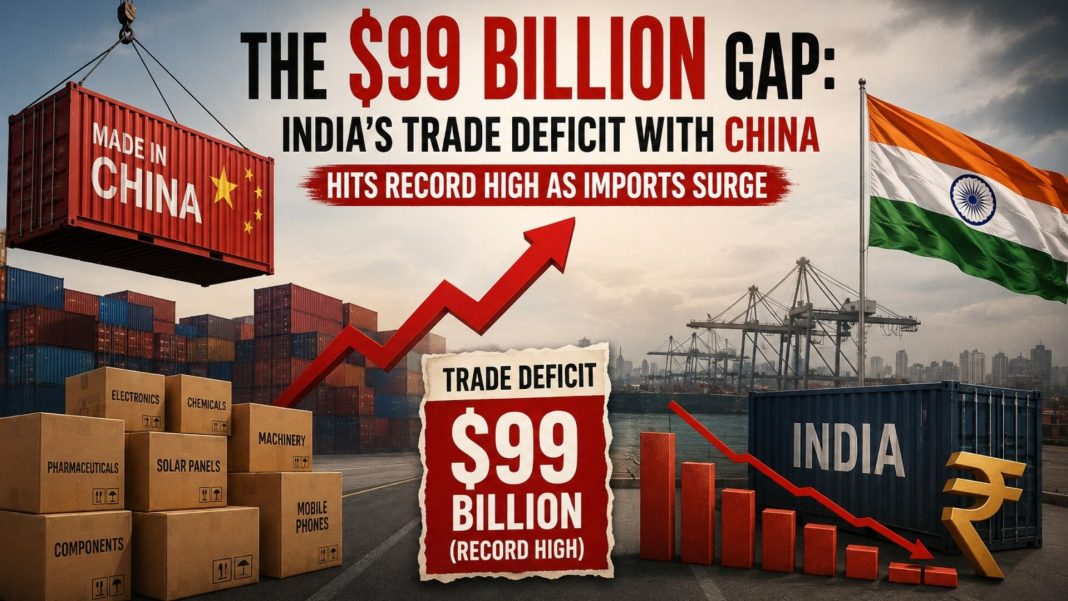

The $99 Billion Gap: India’s economic relationship with China has reached a critical crossroad. Over the past five years, trade between the two Asian giants has grown increasingly one-sided, culminating in a record trade deficit that highlights India’s deepening reliance on Chinese goods despite diplomatic tensions and national efforts to promote self-reliance.
According to official data from the Ministry of Commerce, India’s trade deficit with China has more than doubled, soaring from around $44 billion in FY 2020-21 to an unprecedented $99 billion in FY 2024-25.
The Numbers Behind the Gap: A Five-Year Trend
The $99 Billion Gap: The widening disparity is driven by two starkly opposing trends: a steep surge in shipments arriving from China and a steady decline in Indian goods heading across the border.
Imports Soar: In 2020-21, India imported goods worth $65.21 billion from China. By 2024-25, that number jumped dramatically to $113.46 billion, an increase of nearly 74%.
Exports Slump: Conversely, Indian exports to China contracted sharply. Shipments fell from $21.19 billion in 2020-21 down to $14.25 billion in 2024-25, representing a drop of nearly 33%.
Why Are Imports Rising? The Industrial Hunger for Chinese Inputs
The $99 Billion Gap: The staggering increase in Chinese imports comes even as the Indian government has actively pushed for local manufacturing through schemes like Make in India and Production-Linked Incentives (PLI).
Economists point out an ironic reality: to manufacture goods domestically, Indian industries require heavy inputs of capital equipment, intermediate components, and raw materials, much of which China supplies at unmatched scale and competitive prices.
Key import drivers include:
Electronics & Telecom Equipment: Components for smartphones, laptops, and networking hardware.
Active Pharmaceutical Ingredients (APIs): Essential raw materials required by India’s massive generic drug industry.
Solar & Renewable Energy Components: Photovoltaic cells and modules powering India’s green energy transition.
Industrial Machinery & Chemicals: Machinery used in domestic manufacturing setups across various sectors.
As Indian industries scale up production, their appetite for these critical intermediate inputs has only grown, feeding directly into the import tallies.
The Export Bottleneck: Why Indian Goods Suffer in China
While Chinese products flood Indian markets, Indian exporters face significant hurdles gaining traction in the Chinese mainland.
Composition of Exports: India’s exports to China have traditionally consisted of primary commodities, such as iron ore, refined petroleum, organic chemicals, raw cotton, and agricultural products.
Demand for these materials fluctuates based on China’s domestic economic slowdown and property market conditions.
Non-Tariff Barriers: Indian firms, particularly in sectors like pharmaceuticals, IT services, and agriculture, continue to report regulatory hurdles, complex compliance requirements, and market access delays in China.
Lack of High-Value Finished Goods: Unlike China, which sells high-margin manufactured items, India has struggled to export value-added consumer products to Chinese consumers in large volumes.
Economic & Policy Implications for India
A trade deficit nearing $100 billion presents a dual challenge for Indian policymakers:
Currency and Current Account Pressure: A massive trade gap places structural pressure on the Indian Rupee and widens the current account deficit, leaving the economy more exposed to external shocks.
Supply Chain Vulnerability: Deep dependence on a single trading partner for critical components creates strategic vulnerabilities, particularly during supply chain disruptions or political friction.
The Strategic Paradox: While New Delhi has restricted Chinese mobile apps, scrutinized Chinese foreign direct investment (FDI), and tightened customs checks, trade figures demonstrate that completely decoupling from Chinese supply chains remains economically complex in the short term.
What Lies Ahead: Rebalancing the Scale
To narrow this structural gap, trade experts suggest India must pursue a multi-pronged strategy:
Diversifying Supply Chains: Building alternative sourcing networks across Southeast Asia, Europe, and domestic suppliers to reduce single-source dependency.
Strengthening Domestic Supply Chains: Expanding PLI programs deeper into upstream raw materials and intermediate components, rather than just final assembly.
Negotiating Market Access: Pushing Beijing to remove non-tariff barriers facing Indian pharmaceuticals, IT, and agri-products.
As the numbers stand, the five-year trend underscores a clear economic reality: while India aims to position itself as a global manufacturing hub, its near-term path to industrial growth remains closely intertwined with Chinese imports.
Also Read : US Army Shake-Up: Top General in Europe Fired Just 2 Months Before Term Ends