


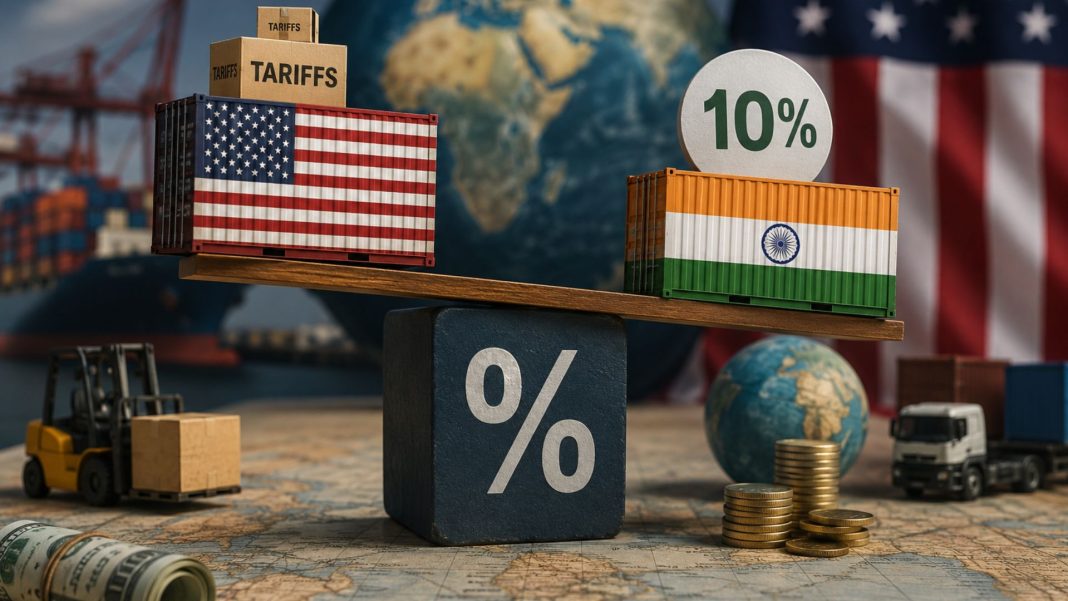

US New Tariffs : The United States has officially introduced a broad new tariff regime targeting imports from 60 major trading partners. Replacing a five-month temporary global tariff structure, the newly enacted measures impose duties ranging between 10% and 12.5% on nearly all goods entering the US market.
The policy, enacted by President Donald Trump’s administration, claims to target gaps in international supply chains, specifically focusing on trading partners that fail to prevent goods produced via forced labor from entering global markets.
While the tariffs cover approximately 99.4% of total US imports, the framework introduces a tiered rate system alongside strategic product exemptions to mitigate economic disruption.
Why the Shift? Supreme Court Ruling Triggers Policy Overhaul
US New Tariffs : The administration’s previous trade strategy relied on executive emergency powers to enforce reciprocal tariffs ranging from 10% to 50%. However, a critical legal setback occurred when the US Supreme Court invalidated those reciprocal tariffs, stripping the White House of its legal justification to maintain duties under national emergency provisions.
Timeline of Policy Shift
Supreme Court Decision: Invalidated the reciprocal tariffs previously put in place.
Section 301 Investigation: The US Trade Representative (USTR) launched a fresh probe.
Public Consultation: Over 1,600 written submissions were collected and reviewed.
Two-Tier Proposal: Proposed tiered tariffs were formally introduced on June 3.
Formal Implementation: Federal Register Notice was published on July 23.
The Section 301 Alternative
To bypass the judicial block, the Office of the United States Trade Representative (USTR) initiated an investigation under Section 301 of the Trade Act of 1974.
Unlike the previous reciprocal regime, Section 301 allowed the USTR to evaluate whether foreign trading partners maintained adequate legal frameworks to ban imports made with forced or coerced labor.
Following public hearings and the review of over 1,600 written submissions, federal trade officials developed a customized two-tiered tariff mechanism linking duty rates directly to labor enforcement.
Inside the Two-Tier Framework
US New Tariffs : The final structure establishes two primary categories for trade partners based on their labor regulations:
Default Tier (12.5% Rate): Applied to nations assessed as having weak enforcement mechanisms or inadequate legislation regarding forced labor products.
Lower Tier (10.0% Rate): Reserved for countries that enforce strict import bans, maintain partial restrictions, or have formally committed to establishing equivalent regulatory frameworks through bilateral negotiations.
The measures came into effect following a Federal Register notice published on July 23, coinciding with the expiration of the 150-day temporary tariff arrangement. To prevent immediate supply disruptions, goods already in transit prior to the deadline were granted a brief grace period.
How India Negotiated a Lower 10% Duty Band
India’s Diplomatic Trajectory
June 3 (Initial Allocation): India was initially placed in the higher tier at 12.5%.
June 14 (Policy Amendment): India updated its Foreign Trade Policy (FTP).
June–July (Bilateral Talks): Intensive engagement took place with the USTR.
July 23 (Tariff Reduction): India was officially reclassified to the lower band at 10%.
From 12.5% Danger Zone to 10% Relief
When the USTR initially unveiled its proposed framework, India was categorized in the higher 12.5% tariff bracket. Over the subsequent weeks, New Delhi engaged in swift diplomatic and regulatory actions to demonstrate alignment with global supply chain standards.
Key Regulatory Amendments
The most decisive move occurred on June 14, when India’s Ministry of Commerce amended the country’s Foreign Trade Policy (FTP). The amendment instituted an explicit prohibition on importing goods produced using forced or coerced labor, directly addressing the core concerns raised in the Section 301 investigation.
“This decision reflects constructive steps taken by certain countries to align foreign trade policies and strengthen the integrity of the global supply chain.”
— Official Presidential Memorandum Excerpt
Economic Relief for Key Indian Export Sectors
By securing the 10% classification, Indian exporters avoid an additional 2.5 percentage point burden. This adjustment brings immediate operational relief to critical export sectors:
Textiles and Apparel
Pharmaceuticals
Engineering Goods
Automobile Components
This step follows another recent easing of trade tensions between the two nations, where Washington removed a separate 25% punitive duty linked to Indian purchases of Russian oil.
US-India bilateral trade in goods reached $141 billion in 2025, with Indian exports accounting for $87.3 billion, making the US India’s largest export destination.
Global Tariff Breakdown: Who Pays What?
The Section 301 assessment split the 60 evaluated economies into specific duty categories based on their regulatory evaluations:
Lower Tier (10.0% Tariff): India, the United Kingdom, Canada, Mexico, Argentina, Bangladesh, Cambodia, Ecuador, El Salvador, Guatemala, Honduras, Indonesia, Jordan, Malaysia, Pakistan, Sri Lanka, and Trinidad and Tobago. These nations met the criteria via active enforcement or formal commitments.
Combined Tier (10.0% to 12.5% Effective Rate): The European Union, Japan, South Korea, Taiwan, and Switzerland. Their rates vary based on most-favored-nation (MFN) duties and specific bilateral trade agreements.
Default Tier (12.5% Tariff): Vietnam, China, and 36 other economies. Assigned the default rate due to regulatory gaps identified by the USTR.
China Special Arrangement (Capped near 20.0%): Chinese imports are subject to separate bilateral agreements that keep duties near the 20% level agreed upon during the bilateral trade ceasefire, rather than stacking full additional penalties.
Exemptions and Protected Sectors
To protect domestic manufacturing and key supply lines, the White House introduced a targeted list of exemptions where the new tariffs will not apply:
Energy Products: Crude oil, natural gas, and refined fuels.
Agricultural Inputs: Selected fertilizers and essential food items.
High-Tech & Logistics: Commercial aircraft, aviation components, and critical minerals.
Existing Security Tariffs: Goods already covered under Section 232 tariffs (e.g., steel, aluminum, copper, and automobiles).
USMCA Goods: Trade conducted under the United States-Mexico-Canada Agreement benefits from broad exemptions due to integrated North American supply chains.
International Backlash and Global Reactions
The universal nature of the tariffs drew immediate pushback from foreign governments, with many challenging the legal and factual basis of the measures.
European Union: Denounced the logic, emphasizing that European labor standards and worker conditions already exceed US requirements.
Australia: Labeled the new tariffs unfair and indicated plans to seek corrective measures.
Brazil: Called the unilateral measures completely unjustified.
Norway: Rejected the US rationale, stating that the tariffs lack proper foundation.
Canada: Adopted a more measured, diplomatic approach focused on continued negotiation.
European Union foreign policy chief Kaja Kallas explicitly rejected Washington’s justification during ASEAN meetings in Manila. Conversely, Canadian trade minister Dominic LeBlanc signaled an intention to pursue constructive dialogue to resolve pending trade issues.
White House Defense: Human Rights and Fair Competition
Responding to global criticism, White House trade officials defended the policy change as a necessary measure to uphold international labor standards and protect domestic businesses.
“The US has banned imports made with forced labor for nearly a century and strictly enforces it. It is time for our trading partners to do the same. Today’s action will serve as a starting point to remedy both a human rights abuse and a distortive trade practice.”
— Jamieson Greer, US Trade Representative Ambassador
The administration rejected claims that the new policy merely repackages the Supreme Court-invalidated reciprocal tariffs, maintaining that Section 301 provides a battle-tested legal foundation capable of withstanding future judicial scrutiny.
Also Read : Indian flights cancelled: 26,000 Indian Flights Cancelled Amid Growing West Asia Crisis