


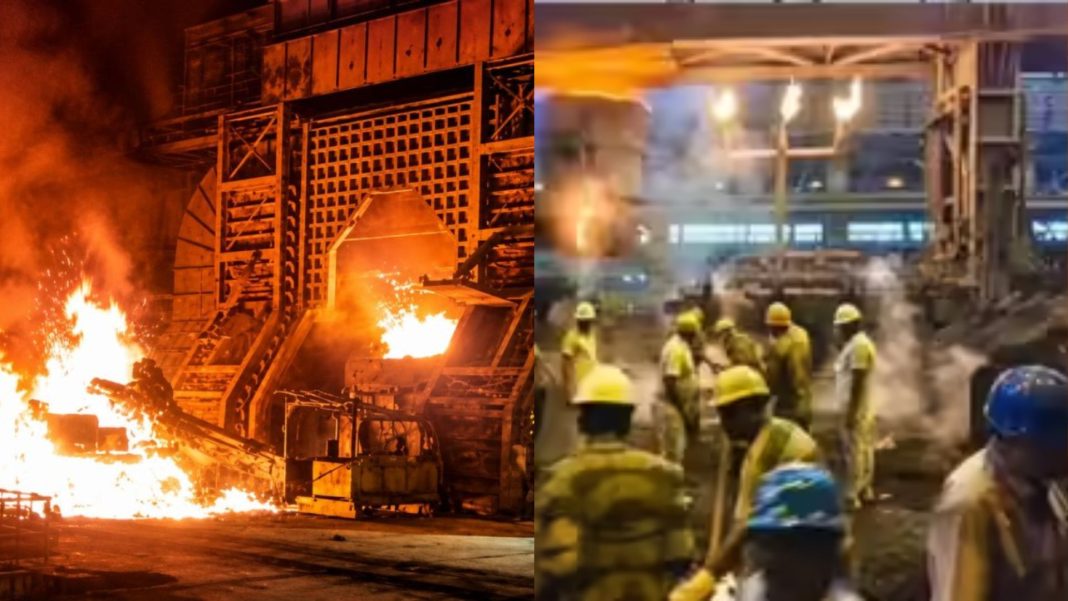

Visakhapatnam Steel Plant Explosion: A devastating industrial accident at the Rashtriya Ispat Nigam Limited (RINL) facility, widely known as the Visakhapatnam Steel Plant (VSP) in Andhra Pradesh, has left at least eight workers dead and six others critically injured.
The tragedy occurred on Monday afternoon following a powerful explosion involving a ladle containing superheated liquid steel.
The blast triggered a massive fire inside the facility and spilled hundreds of tonnes of molten steel across the shop floor.
Emergency rescue teams, local police, and fire tenders rushed to the spot to bring the situation under control, launching a multi-departmental relief operation.
How the Ladle Blast Triggered the Disaster
Visakhapatnam Steel Plant Explosion: According to local administrative officials and the Press Information Bureau (PIB), the incident took place around 4:15 PM at the plant’s Steel Melting Shop (SMS) unit.
Workers were preparing to transfer hot liquid steel from a large ladle into a tundish before sending the material to the continuous casting department.
Before the slide gate could open, a sudden and powerful explosion caused the ladle carrying around 150 tonnes of liquid metal to topple over.
The molten steel, which was at an extreme temperature of nearly 1,600 degrees Celsius, instantly spilled onto the workers standing in the immediate vicinity.
The sheer heat caused a massive ball of fire that reached the facility’s ceiling, trapping several personnel on the shop floor in dense smoke and towering flames.
Emergency operations were complicated because the accident happened during a shift change, making it difficult to immediately account for everyone present.
Firefighters and safety personnel battled the flames for nearly 90 minutes before they could safely enter the core blast zone to retrieve the victims.
Details of Casualties and Injured Personnel
Visakhapatnam Steel Plant Explosion: Visakhapatnam District Collector M. Abhishikth Kishore confirmed that the deceased included five regular employees and three contract workers. The factory technician and a general foreman were reportedly among those who lost their lives on the spot.
Six other workers sustained severe burn injuries, ranging from 40% to 90%.
They were immediately transported via 108 ambulance services to the steel plant’s hospital and were later shifted to premier private corporate hospitals in the city, including KIMS and Seven Hills Hospitals, as their conditions deteriorated.
Medical authorities have placed specialized care units on alert to handle the critical burn cases.
Government and Official Response
Prime Minister Narendra Modi expressed deep grief over the industrial tragedy.
Taking to X (formerly Twitter), the Prime Minister extended his condolences to the bereaved families and announced financial assistance from the Prime Minister’s National Relief Fund (PMNRF).
An ex-gratia payment of ₹2 lakh will be given to the next of kin of each deceased worker, and ₹50,000 will be provided to those injured.
Andhra Pradesh Chief Minister N. Chandrababu Naidu stated he was “deeply shocked” by the disaster.
He directly coordinated with the City Police Commissioner Shankhabrata Bagchi and the District Collector to oversee swift rescue measures.
As a mark of respect for the victims, the Chief Minister postponed a major public alliance meeting that was scheduled to take place in Tirupati.
Union Minister of State for Steel, B. Srinivasa Varma, termed the incident highly unfortunate and confirmed that a high-level probe has been initiated.
A three-member external inquiry committee led by the director-in-charge of the Bokaro Steel Plant under SAIL has been formed to look into the technical and structural aspects of the failure.
Labor Unions Flag Safety and Maintenance Issues
The latest tragedy has renewed serious concerns regarding operational protocols and safety standards at the public sector steel plant.
Trade union leaders from the Center of Indian Trade Unions (CITU) and the Indian National Trade Union Congress (INTUC) have alleged that severe manpower shortages and compromised maintenance routines contributed to the mishap.
According to union representatives, a minor blast and fire had occurred in the ladle furnace bay about 40 minutes before the fatal explosion, but it was controlled quickly, and operations were resumed without thorough inspection.
Labor groups are demanding full accountability from senior management, pointing out that thousands of positions have remained vacant over the past few years, increasing pressure on the existing workforce and impacting critical safety checks.