


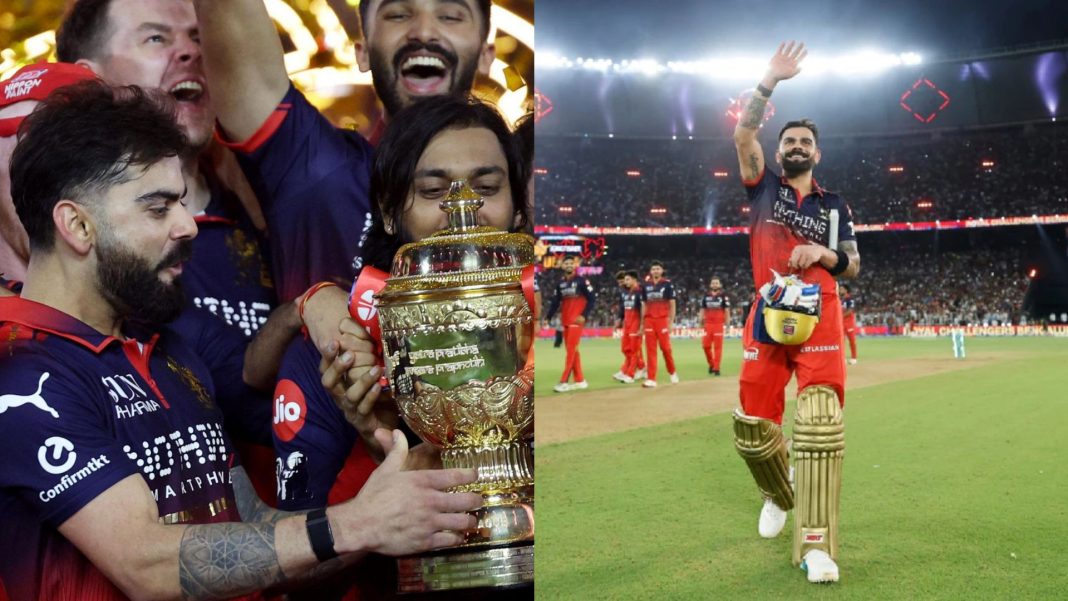

Kohli’s Unbeaten 75 Sparks Glory: For nearly two decades, the phrase “Ee Sala Cup Namde” (This year the cup is ours) was whispered with a mix of desperate hope and heartbreaking irony by millions of fans.
For 17 seasons, Royal Challengers Bengaluru (RCB) carried the tag of the “ultimate underachievers,” falling short at the final hurdle three times. The narrative that RCB was cursed to never win an IPL title felt less like a myth and more like an unshakeable reality.
However, everything changed in 2025 when the curse was finally shattered at Ahmedabad against the Punjab Kings, forcing a tearful Virat Kohli to his knees in pure relief.
Fast forward to the IPL 2026 final on Sunday night, and a completely transformed, ruthless RCB outfit stepped onto the pitch at the Narendra Modi Stadium.
Defeating Shubman Gill’s Gujarat Titans (GT) comfortably by five wickets, RCB did what was once deemed impossible: they defended their crown and became only the third team in IPL history (after CSK and MI) to win back-to-back titles.
Total Powerplay Demolition: Getting Rid of Gill and Sudharsan Early
Kohli’s Unbeaten 75 Sparks Glory: Heading into the final, Gujarat Titans’ blueprint for success relied heavily on their prolific opening duo captain Shubman Gill and Sai Sudharsan. Having stitched together a monumental 167-run partnership in Qualifier 2, they were the undisputed engine room of the GT batting lineup.
RCB’s bowling spearheads, Josh Hazlewood and Bhuvneshwar Kumar, executed their plans flawlessly under immense pressure. Hazlewood extracted extra bounce to remove Gill for just 10 runs, while Bhuvneshwar tricked Sudharsan (12) with a beautiful piece of swing bowling.
Dismantling both orange-cap contenders inside the first six overs reduced GT to a crawling 45/2. On a batting-friendly track where 60–70 run powerplays were the norm, RCB had already completed half their defensive job.
The Middle-Over Choke: 41 Balls Without a Single Boundary
Kohli’s Unbeaten 75 Sparks Glory: While losing the openers was a severe blow, GT still harbored hopes of rebuilding a competitive total exceeding 180. Those hopes went completely up in smoke during a staggering middle-overs choke orchestrated by RCB’s spin department.
From the final ball of the powerplay to the fourth delivery of the 13th over, Gujarat Titans failed to hit a single boundary. For 41 consecutive deliveries, the home team was suffocated, scratching together just 30 runs.
All-rounder Krunal Pandya played the role of the chief tormentor, giving away a measly 13 runs in his first three overs and claiming the massive, prized scalp of Jos Buttler. GT’s explosive engine room was successfully starved of oxygen.
Rasikh Salam Dar’s Lethal Double-Strike in the Death
Even with the run rate severely dented, the dangerous Rahul Tewatia and a heavily capable Rashid Khan walked out, threatening a late-innings explosion. Enter Rasikh Salam Dar.
The Jammu and Kashmir pacer produced a masterclass in death bowling.
Tasked with the 17th over, Rasikh dismissed the proven finisher Tewatia on the very first delivery of his new spell, caught safely by Rajat Patidar at mid-on.
Rashid Khan threatened briefly by smoking Rasikh for a maximum at the start of the final over, but the young speedster extracted immediate revenge, forcing Rashid to hole out to deep backward square leg on the next ball.
Rasikh finished with stellar figures of 3/27, restricting GT to a completely sub-par total of 155/8.
Kohli and Iyer’s Blazing 62-Run Powerplay Attack
Defending a modest total of 155 requires early, devastating breakthroughs. In past IPL finals, teams have successfully defended sub-160 totals by triggering top-order panics. GT desperately needed the wicket of Virat Kohli to instill doubt in the chase.
Instead, Virat Kohli and his opening partner Venkatesh Iyer walked out with intent, effectively ending the contest within the first 30 minutes. The duo relentlessly plundered 62 runs inside the first 5 overs.
By using the field restrictions to perfection and punishing anything short or wide, they dragged the required run rate well below 7 runs per over from the very outset, putting one hand firmly on the IPL trophy.
Quelling the Rashid Threat: Taking the Pressure Off Tim David
A momentary tremor went through the RCB camp in the 9th over when Afghan maestro Rashid Khan struck twice in three balls, removing Rajat Patidar and Krunal Pandya. At 2 wickets down in quick succession, new batter Tim David walked out to face a roaring stadium, with GT sensing a microscopic window of a comeback.
The pressure needed to be maintained, but seam-bowling all-rounder Jason Holder delivered a disastrous subsequent over. Holder began with a loose delivery down the leg side, which Kohli effortlessly flicked for a boundary.
Later in the over, Tim David smashed a confident boundary to get off the mark and bring up RCB’s 100. That single over leaked critical runs, completely neutralized the pressure created by Rashid, and allowed RCB to cruise comfortably to the finish line.
From Tragic Myths to a Ruthless Dynasty
For 17 years, critics argued that RCB’s team structure was a flawed myth too top-heavy, lacking bowling teeth, and mentally fragile in knockout matches.
The back-to-back championships of 2025 and 2026 have emphatically buried that narrative forever.
This wasn’t a team relying purely on individual miracles; it was a cohesive unit where the bowlers choked opposition lineups, the middle-order absorbed pressure, and Virat Kohli provided the masterly, unbeaten anchor (75* off 42 balls) to finish the job.
Fittingly, Kohli sealed the title with a magnificent six over long-on, proving that Bengaluru is no longer a franchise hoping to win it is a franchise thoroughly used to winning.
Also Read: Vaibhav Sooryavanshi IPL Record: 15-Year-Old Smashes 29-Ball 97, Breaks Gayle’s Historic Milestone