


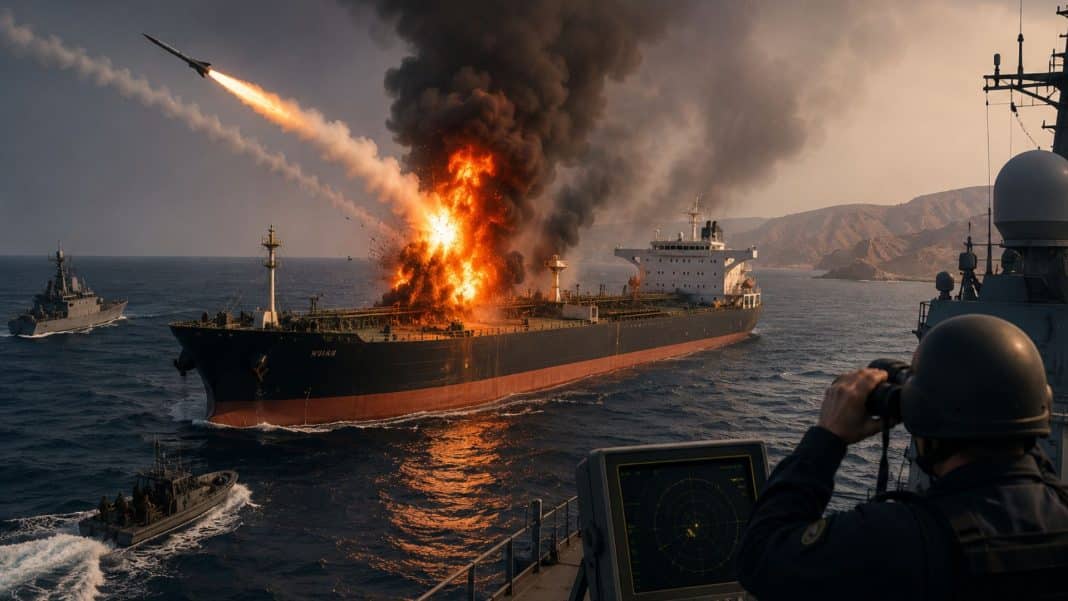

Gulf On Edge: According to an official advisory issued by the UKMTO, the maritime security agency received reports of a sudden projectile strike targeting a merchant vessel.
The attack took place several nautical miles southeast of the Omani coast, a high-traffic zone serving as a precursor route to the highly volatile Strait of Hormuz.
While detailed assessments are underway, early details surrounding the incident reveal the immediate stakes:
The Incident: An unidentified missile or projectile directly impacted a commercial oil tanker during its standard transit.
Current Status: Official details regarding the structural damage to the vessel, the volume of cargo compromised, or exact casualty numbers remain unconfirmed as emergency teams communicate with the ship.
The Investigation: UKMTO, alongside regional naval coalitions, has launched an active investigation into the coordinates of the strike to determine the trajectory of the weapon.
No group has officially claimed responsibility for the strike, though regional security analysts point to the ongoing asymmetric warfare dominating the Gulf corridors.
Strategic Shipping Lanes Turn into Active Combat Zones
Gulf On Edge: This strike marks a hazardous deterioration of safety for merchant navies. Coming closely on the heels of recent missile strikes on UAE-flagged vessels, which resulted in the tragic loss of an Indian seafarer, the waters off Oman have effectively transformed from a diplomatic gray zone into an active combat theater.
Defense analysts warn that these recurring strikes underscore a critical tactical shift:
Expanded Target Range: Hostile actors are no longer limiting their operations to the narrowest choke points of the Persian Gulf; they are actively pushing their strike capabilities further south into the open Arabian Sea and Omani territorial limits.
Intelligence Gaps: The continuous targeting of neutral merchant vessels suggests that automated targeting systems, sea mines, and shore-to-ship cruise missiles are being deployed indiscriminately, creating an environment where any passing vessel risks collateral damage.
The Financial Fallout: Skyrocketing Insurance Premiums and Surcharges
Gulf On Edge: For global energy markets, a missile strike off the coast of Oman acts as a direct catalyst for financial panic. Even before damage or ownership details emerge, the maritime insurance market reacts instantly.
- War-Risk Insurance Spikes
Maritime underwriters are expected to reclassify the southeastern waters of Oman as a high-risk zone. This single change will cause war-risk insurance premiums to surge, adding hundreds of thousands of dollars to the operational cost of a single voyage.
- Surcharges and Freight Re-routing
If the frequency of unprovoked missile strikes continues to escalate:
Shipping lines will be forced to introduce emergency risk surcharges, passing the costs directly to importing nations.
Massive shipping conglomerates may instruct their fleets to completely bypass the Gulf route, opting for longer, far more expensive paths around the African continent, delaying delivery schedules by weeks.
High Stakes for India: Energy Security and Seafarer Welfare
Few nations are as vulnerable to trade disruptions in the Omani corridor as India. With New Delhi relying heavily on the Middle East to satisfy its immense energy needs, this latest strike hits close to home.
Crude and Gas Lines Threatened: India imports more than 85% of its crude oil requirements, a vast portion of which passes directly through the waters off Oman. Any disruption or escalation that deters tankers will immediately put pressure on domestic fuel prices and inflate the national import bill.
The Human Element: Given that Indian nationals comprise a substantial percentage of the global merchant navy workforce, the news of another missile striking a tanker causes severe anxiety within the maritime community. Indian crews face the brunt of the physical danger as geopolitical standoffs turn lethal.
What Lies Ahead
As the UKMTO and allied naval forces work to establish the identity of the vessel and the source of the missile, the global shipping industry remains on high alert.
With geopolitical rhetoric intensifying, this latest strike serves as a stark reminder that the world’s most vital energy arteries are running on borrowed time.