


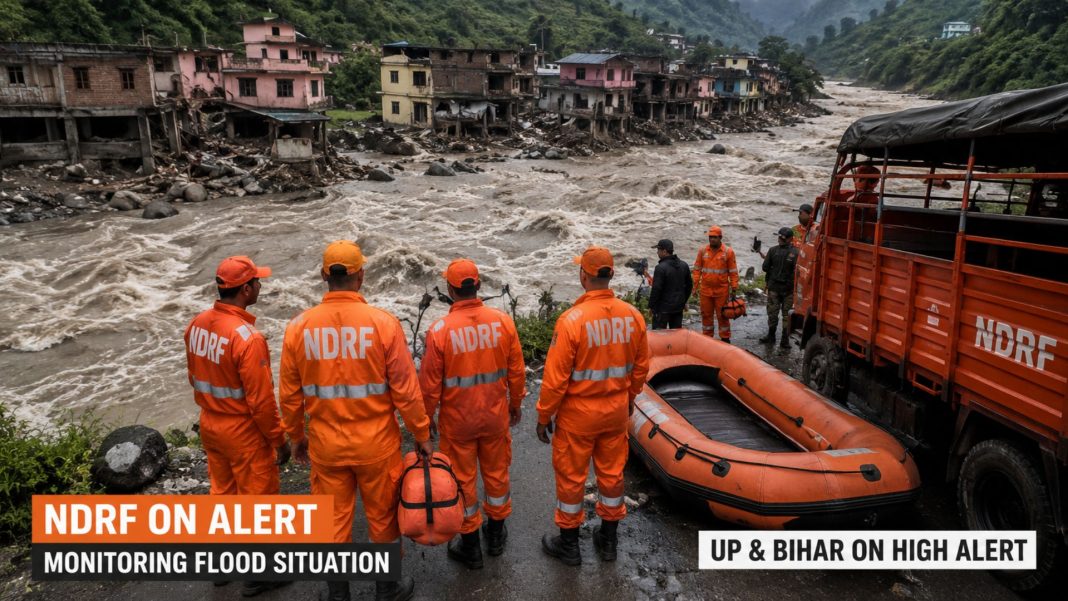

Nepal Flash Floods: Following catastrophic flash floods triggered upstream in Nepal, Indian disaster management authorities have initiated large-scale precautionary measures across border districts in Uttar Pradesh and Bihar.
According to media reports, the National Disaster Response Force (NDRF) has deployed 20 specialized units 11 in Uttar Pradesh and 9 in Bihar to launch rapid rescue and relief operations should river surges cross critical safety levels downstream.
During an official briefing, NDRF Inspector General Narendra Singh Bundela clarified that despite severe destruction in Nepal’s high-altitude valleys, the floodwaters have not resulted in any immediate adverse impact inside Indian territory so far.
Emergency response agencies, in close coordination with the Central Water Commission (CWC) and state governments, are maintaining round-the-clock surveillance along border river basins.
Devastation Upstream: Glacial Outburst and Surge along Bhote Koshi
Nepal Flash Floods: As per media reports, the crisis originated when a massive surge engulfed the Bhote Koshi river system in Nepal’s northern Rasuwa district, bordering Tibet.
Initial investigations by hydrologists indicate that a suspected Glacial Lake Outburst Flood (GLOF) combined with intense localized rainfall unleashed a torrent of mud, boulders, and water.
The high-velocity deluge swept through mountain settlements, destroying critical infrastructure, bridges, and power lines.
According to media reports citing Nepalese emergency officials, recovery operations have yielded hundreds of casualties across multiple districts including Nuwakot, Dhading, and Chitwan, while hundreds of individuals including foreign tourists remain unaccounted for in upper Himalayan transit points.
Monitoring River Networks: From Trishuli to the Gandak Basin
Nepal Flash Floods: The geographical path of the flood surge presents a potential threat to North India’s agricultural belt:
River Flow Trajectory: The swollen Bhote Koshi merges downstream into the Trishuli River. The Trishuli later joins the Kali Gandaki to form the Narayani River, which eventually crosses the international border into Bihar’s West Champaran district as the Gandak River.
Impact on Uttar Pradesh: Beyond Bihar, the Gandak river system flows through eastern Uttar Pradesh districts, notably Kushinagar, Gorakhpur, and Deoria.
Barrage Regulation: As per media reports, disaster management authorities at the Valmiki Nagar Barrage in Bihar the primary water control structure at the border are closely monitoring the situation.
Officials noted that gauge site levels downstream remain within manageable limits, providing temporary buffer time.
Ground Preparedness and International Assistance
To prevent loss of life in vulnerable floodplains, local administrations in border districts such as West Champaran, Gopalganj, Kushinagar, and Maharajganj have initiated precautionary evacuations from low-lying areas near river embankments.
District authorities are using public address systems to urge residents to move livestock and valuables to elevated platforms.
Furthermore, four additional NDRF teams have been placed on standby at the Hindon Air Force Station in Ghaziabad, Uttar Pradesh.
According to media reports, these airlift-ready units can be dispatched to Kathmandu at short notice should the Nepalese government formally request bilateral international assistance.
While structural damage upstream in Nepal remains extensive, continuous monitoring by the Central Water Commission and strategic barrage operations have kept border communities in UP and Bihar safe from immediate flash flooding.