


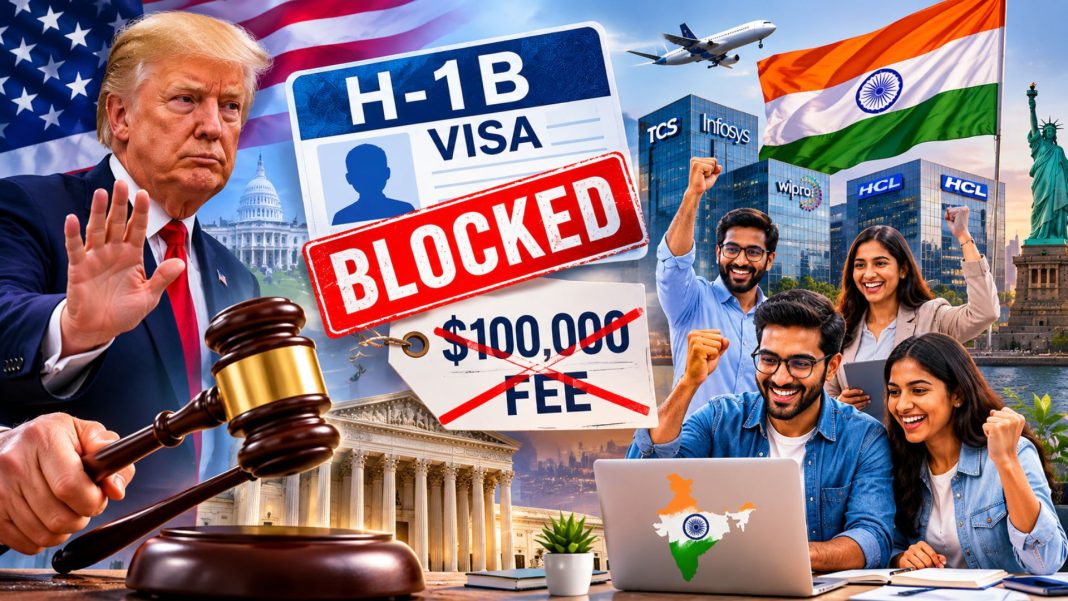

H-1B Visa Fee Blocked: The U.S. Federal Court’s decision to block President Donald Trump’s proposed $100,000 fee on H-1B visas has come as a massive relief for India. The H-1B visa program is the lifetime support system for Indian software engineers and global IT giants like TCS, Infosys, and Wipro.
If District Judge Richard Stearns had not stopped this proposal, the dream of working in the U.S. would have become nearly impossible for thousands of Indian professionals. This ruling not only protects Indian talent but also saves the Indian IT sector from massive financial damage.
Why this Matters to India: The Numbers Behind the Visa
H-1B Visa Fee Blocked: India is the biggest beneficiary of the H-1B visa program. Every year, Indian citizens secure nearly 70% to 75% of the total H-1B visas issued by the United States.
The proposed $100,000 (around ₹83 Lakhs) fee would have created severe roadblocks:
Unbearable Costs: Indian tech companies operating in the U.S. would face a multi-million dollar jump in operational expenses.
Hiring Freeze for Indians: U.S. employers would stop sponsoring Indian engineers simply because it would be too expensive, drastically cutting down job opportunities for Indians abroad.
The Legal Turning Point: Stability for Indian Businesses
H-1B Visa Fee Blocked: Judge Stearns ruled that President Trump’s September 2025 announcement violated the constitutional separation of powers. He emphasized that only the U.S. Congress has the right to set such huge fees, not the President.
For Indian IT companies, this legal victory provides much-needed stability. It proves that U.S. immigration laws cannot be changed overnight by executive orders. This allows Indian tech firms to plan their business strategies and project deployments without immediate fear of sudden financial penalties.
Trump’s ‘America First’ vs. India’s Tech Power
President Trump and his supporters argue that the H-1B program hurts American workers by replacing them with cheaper foreign labor. Trump stated that this practice threatens U.S. national security and its leadership in science and technology.
However, industry experts point out that Indian engineers are the backbone of Silicon Valley. Tech giants like Google and Microsoft rely heavily on Indian minds.
Because the U.S. faces a natural shortage of local students graduating in Science, Technology, Engineering, and Math (STEM), stopping Indian talent would ultimately hurt American innovation.
Current Framework and Indian Dominance
The U.S. currently caps its annual H-1B visas at 85,000 (65,000 for standard applicants and 20,000 for those with a U.S. Master’s degree).
To hire an Indian professional, companies must already clear strict rules set by the U.S. Department of Labor. They must certify that hiring a foreign worker will not lower the wages or harm the working conditions of local American workers.
Because Indian techies meet these high-skill requirements perfectly, they continue to dominate the selection process.
The Outlook: What This Means Going Forward
While this court ruling is a celebratory moment for Indian IT professionals and students aspiring to move to the U.S., the underlying tension remains.
Indian tech companies are fully aware that the Trump administration will continue its strict stance on immigration. To prepare for future political hurdles, major Indian IT firms are already adapting by hiring more local Americans and expanding their local offices in the U.S., decreasing their complete dependence on visas.
Also Read : Tensions Peak in West Asia: US Apache Helicopter Crashes Near Strait of Hormuz