


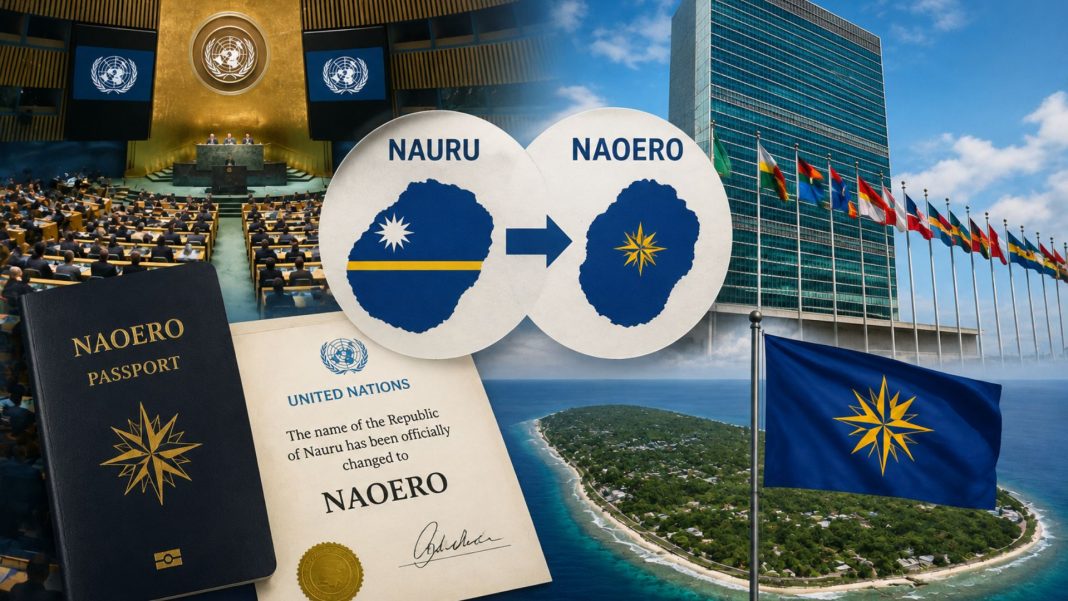

Major Change in UN Records: In a historic step to honor its indigenous identity and heritage, the Pacific island nation of Nauru has officially changed its international name to the Republic of Naoero.
The United Nations has updated its records to reflect the native designation, replacing a colonial-era mispronunciation with the name used by its original inhabitants for centuries.
With a population of just 12,000, Naoero is the world’s third-smallest sovereign state by land area. Government officials emphasized that the decision is far more than a mere bureaucratic detail, it represents a profound cultural reclaiming.
For generations, “Nauru” served as a convenient exonym for foreign powers, traders, and diplomats. By officially adopting “Naoero,” the island nation joins a growing international movement of countries shedding foreign-imposed titles to reflect their authentic language, culture, and history.
From Tribal Peace to Colonial Conflict: A Tragic Wedding Dispute
Major Change in UN Records: To understand Naoero’s journey to self-determination, one must look back to its isolated past. Until the late 19th century, the island was home to 12 distinct indigenous tribes.
Living without a centralized government or formal standing army, the native population relied on traditional fishing, coconut cultivation, and local marine resources.
However, the arrival of European traders in the 1870s drastically altered the island’s social dynamic. Foreign merchants introduced firearms and alcohol in exchange for local goods, unsettling the delicate balance between the tribes.
The 10-Year Civil War
Major Change in UN Records: In 1878, a minor dispute over custom broke out during a local wedding celebration. Tensions escalated rapidly when a firearm was discharged, killing the son of a tribal chief. Under traditional custom, blood retribution was considered a strict social obligation.
This single shooting ignited a cycle of vengeance that consumed the island:
Decade-Long Feud: A violent decade-long conflict erupted, known today as the Naoero Civil War.
Widespread Devastation: The fighting involved all 12 tribes, decimating villages and wiping out a significant portion of the population.
Colonial Annexation: Seeing the ongoing turmoil, Germany intervened in 1888, disarming the tribes, seizing control, and incorporating the island into German New Guinea.
A Tug-of-War Between Empires
Naoero’s geopolitical importance soared at the turn of the 20th century. Following decades under German authority, global events reshaped the island’s political destiny during World War I.
Historical Timeline:
Pre-1888 (Native Tribal Rule): Traditional communal living among 12 indigenous tribes.
1888–1914 (German Empire): Annexation following the end of the 10-year civil war.
1914–1968 (Australia / UN Trusteeship): Australian forces seized control during WWI; later administered under a UN mandate.
1968–Present (Sovereign Republic): Achieved full independence on January 31, 1968.
Australia seized control of the island from Germany in 1914 without military resistance. After World War I, the League of Nations mandated the territory to Australia, New Zealand, and the United Kingdom.
Following a brief, brutal Japanese occupation during World War II, Australia resumed administration under a UN trusteeship until January 31, 1968, when the nation finally secured full independence.
The White Gold Rush: How Phosphates Built, and Broke, a Nation
In 1900, Australian geologist Albert Fuller Ellis discovered vast deposits of high-grade phosphate on the island. Often referred to as “white gold,” phosphate was in massive global demand as a primary ingredient for agricultural fertilizers. Commercial mining began in 1906, permanently altering Naoero’s economic and physical landscape.
Economic Evolution:
1900: Discovery of massive phosphate deposits.
1968: Independence and nationalization of the mining industry.
1970s: Peak prosperity, achieving one of the highest global GDPs per capita.
1990s: Resource depletion leading to severe economic collapse.
The Golden Era
After gaining independence in 1968, the local government nationalized the mining operations. By the 1970s, Naoero had become one of the wealthiest countries in the world per capita. The sudden surge of wealth funded:
Free healthcare and education for all citizens.
Complete tax exemptions for residents.
Heavy international investments in luxury real estate, hotels, and airlines.
The Resource Curse
The boom, however, was unsustainable. Over-mining rapidly depleted the island’s finite phosphate reserves by the late 1990s. Compounded by poor offshore investments and financial mismanagement, the economy collapsed.
The very commodity that transformed the tiny island into an international economic powerhouse ultimately left it financially destitute, a deficit from which it is still struggling to recover.
Dual Crises: Environmental Ruin and Rising Seas
Today, Naoero faces a far more existential threat than economic instability: the impending impacts of global climate change.
- Extreme Coastal Erosion
As a low-lying Pacific island, Naoero is uniquely exposed to rising ocean levels:
Rising Sea Levels: Satellite data shows sea levels around Naoero rising by roughly 5 millimeters per year since 1993, well above the global average.
Future Projections: Climate models estimate sea levels could rise by an additional 20 to 57 centimeters by the end of this century, threatening to swallow coastal infrastructure.
- Loss of Habitable Land
The nation’s historical dependency on phosphate mining has severely restricted its geographical options:
Barren Interior: Decades of strip-mining stripped the island’s interior, leaving nearly 80% of the land area as an unusable terrain of jagged limestone pinnacles.
Coastal Crowding: Because the interior is uninhabitable, virtually the entire population lives along the vulnerable coastline (the remaining 20%), directly in the path of severe storm surges and coastal erosion.
Economic Solutions for Survival
To combat these environmental threats, the government has launched innovative financing models, including investment-for-citizenship initiatives. Funds generated from these programs are earmarked for long-term climate resilience, including constructing sea walls and relocating communities to higher elevation zones in the island’s interior.
A Global Trend: Reclaiming Native Identity
Naoero’s official name change aligns with a broader international movement of sovereign nations shedding colonial terminology in favor of indigenous endonyms.
“A nation’s true identity is not merely defined by its geographical boundaries, but by its native language, history, and the sovereignty of its people.”
Recent Notable Global Name Changes:
Eswatini (2018): Formerly known as Swaziland, King Mswati III officially renamed the nation to mark its 50th year of independence and remove confusion with Switzerland.
Türkiye (2022): The country updated its official UN registration from Turkey to Türkiye to better represent its culture, spelling, and national language.
Republic of Naoero (Present): Officially reclaiming its native name to honor its 12 founding tribes and linguistic heritage.
By reclaiming its original name, the Republic of Naoero signals a resolute commitment to preserving its ancestral culture as it navigates the complex economic and environmental realities of the 21st century.