


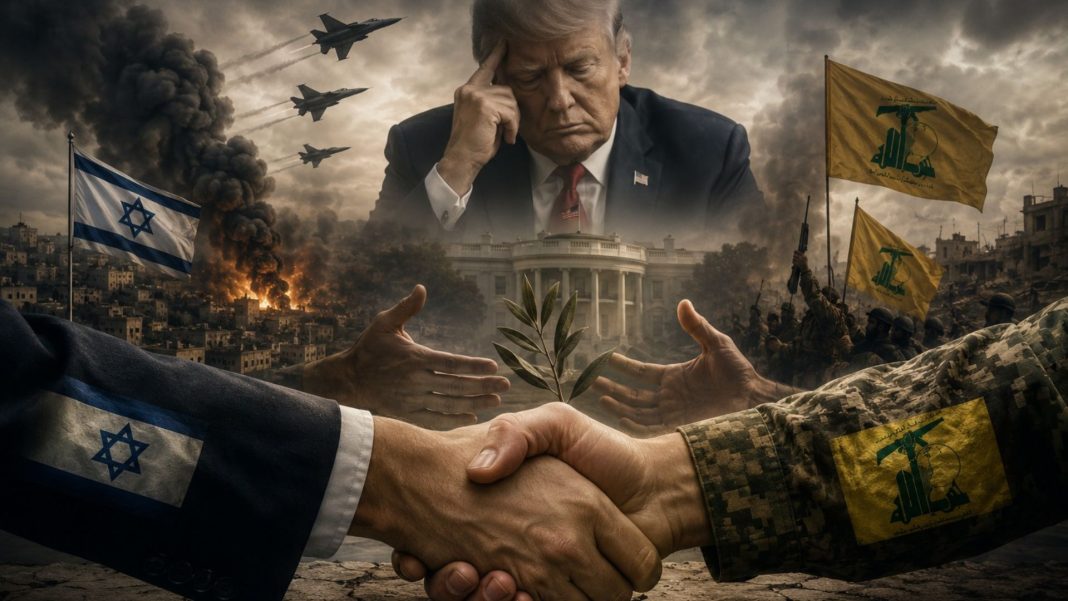

Middle East tensions: A newly brokered ceasefire between Israel and Hezbollah went into effect at 4:00 PM local time (1300 GMT) on Friday, June 19, 2026.
The high-stakes truce, coordinated by U.S. and Qatari mediators following direct diplomacy with Israel and Iran, arrives at a critical juncture. Recent deadly clashes in Lebanon had pushed a broader, fragile West Asia peace agreement to the brink of collapse.
While the ceasefire offers a temporary reprieve, it highlights growing structural friction between Washington and its closest regional ally, Israel, alongside intense domestic and international skepticism over the evolving U.S.-Iran diplomatic framework.
The Anatomy of the Deal: U.S.-Qatari Diplomacy Under Pressure
Middle East tensions: The immediate trigger for the ceasefire was a severe escalation of violence in Lebanon, which threatened to derail a sweeping agreement between the United States and Iran aimed at ending the West Asia war.
The geopolitical friction was pronounced enough to force the postponement of highly anticipated diplomatic talks in Switzerland, which were set to feature U.S. Vice President J.D. Vance.
To salvage the broader peace architecture, U.S. and Qatari officials engaged in rapid, back-channel negotiations with both Israeli leadership and Tehran.
According to diplomatic sources, the primary objective was to establish an immediate cessation of hostilities to prevent a localized border conflict from unraveling months of broader diplomatic maneuvering.
A Shift in Tone: The White House Rebukes Jerusalem
Proportionality and Frustration at the G7
Middle East tensions: The ceasefire follows a series of unusually blunt public statements from U.S. President Donald Trump regarding Israel’s military strategy. Speaking at the G7 summit in France, President Trump expressed explicit frustration with the scale of Israeli retaliatory strikes in Lebanon, urging a “complete ceasefire on all fronts.”
“When two drones are shot into the desert and drop harmlessly, you don’t have to knock down buildings in Beirut. They could behave better, and frankly they could do a better job.”
— U.S. President Donald Trump
The critique signals a shifting calculus in Washington, where administrative patience is wearing thin over the humanitarian toll and the strategic utility of urban bombardment in Lebanon.
The Vice President’s “Reality Check”
Simultaneously, Vice President J.D. Vance delivered a sharp rebuke directed at hardline ministers within the Israeli cabinet who have been vocal critics of the broader U.S.-Iran agreement.
In a White House briefing, Vance emphasized Israel’s growing diplomatic isolation, warning its leadership against alienating its primary global backer.
Vance noted that President Trump remains uniquely sympathetic to Israel on the global stage, adding a stark warning: “If I was in the cabinet of the Israeli government, I might not be attacking the only powerful ally that I have anywhere left in the entire world.”
The 60-Day Clock: Trump Defends the Iran Framework
The Rhetorical Battle with Tehran
Beyond managing relations with Israel, the Trump administration is actively defending the merits of its agreement with Iran against both foreign adversarial rhetoric and domestic critics.
Following a statement by Iranian Supreme Leader Mojtaba Khamenei, who claimed the U.S. entered negotiations “out of desperation,” President Trump fired back on social media.
Trump maintained that it was Tehran, hobbled by sanctions and regional containment, that sought the truce from a position of weakness.
The Domestic Backlash Over Sanctions and Funding
The administration faces significant bipartisan pushback at home. Both Republican hawks and Democrats have heavily criticized the current framework, pointing to provisions that include substantial sanctions relief for Tehran and the establishment of a $300 million reconstruction fund.
Critics argue these concessions reward Iran without implementing sufficiently rigid, verifiable limits on its nuclear program. Trump countered these arguments by stating that Iran is now fundamentally “diminished” and clarified that the U.S. will strictly evaluate compliance over a probationary 60-day window.
“They get no money, not ten cents!” Trump asserted, emphasizing that long-term relief remains contingent on subsequent negotiations.
Strategic Outlook: A Highly Volatile Transition Period
The Israel-Hezbollah ceasefire functions less as a final peace settlement and more as a high-wire stabilization effort. Moving forward, the truce faces three distinct vulnerabilities:
First, Lebanese border stability remains precarious. Any rogue drone launch or rocket fire could re-trigger full-scale Israeli retaliation, collapsing the localized truce instantly.
Second, internal political pressure within Israel’s coalition government may push hardline ministers to advocate for continued operations despite explicit warnings from Washington.
Finally, the 60-day deadline creates an intense countdown. This interim period requires Washington and Tehran to thrash out a permanent deal; any failure to reach common ground by the end of this window risks restarting the entire regional conflict cycle.
As the clock ticks down, the Trump administration finds itself balancing the demands of an aggressive ally in Jerusalem, a deeply distrusted adversary in Tehran, and a skeptical Congress at home.