


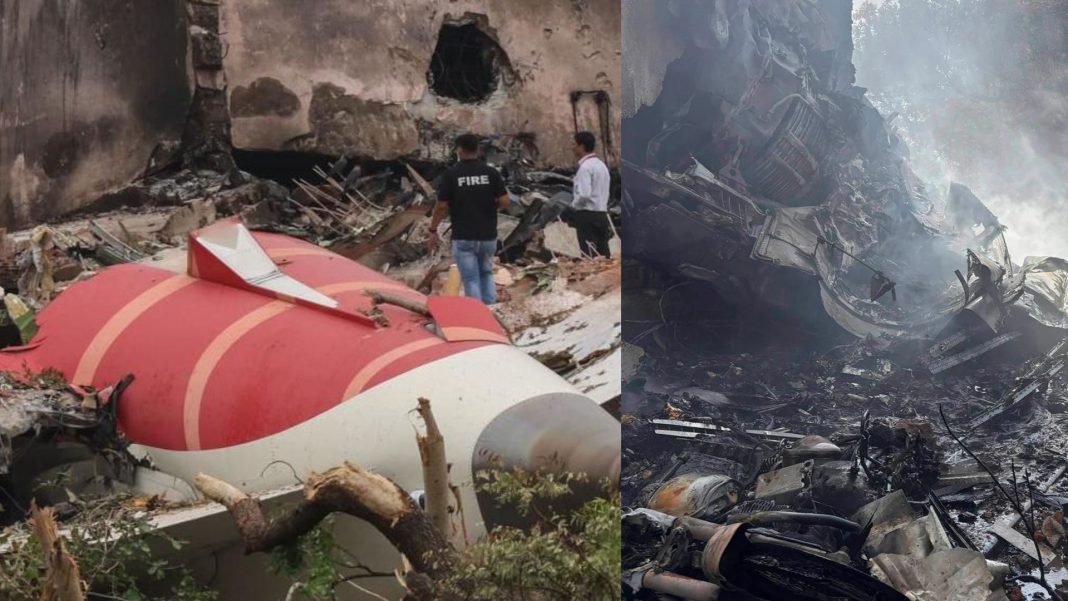

One Year After Ahmedabad Plane Crash: On June 12, 2025, Air India Flight AI171, bound for London’s Gatwick Airport, lifted off from Ahmedabad’s Sardar Vallabhbhai Patel International Airport. Moments later, it plunged into a nearby residential hostel complex.
Today, as the global aviation community marks the first anniversary of the disaster that claimed 260 lives, the central question of the inquiry remains unresolved.
Under International Civil Aviation Organization (ICAO) guidelines, accident investigation authorities are encouraged to release a final report within one year.
However, high-level sources and recent media coverage from agencies such as Reuters and Bloomberg indicate that India’s Aircraft Accident Investigation Bureau (AAIB) will miss this target.
According to officials, the inquiry remains highly complex, requiring extended technical assessments of the aircraft’s propulsion and engine management systems before a final conclusion can be reached.
The Final 9 Minutes: A Detailed Chronology of Flight AI171
One Year After Ahmedabad Plane Crash: According to the AAIB’s preliminary report published on July 12, 2025, and supplementary airport surveillance footage, investigators established a precise timeline of the aircraft’s final moments:
05:47 GMT: The Boeing 787-8 (VT-ANB) lands routinely in Ahmedabad after completing a domestic leg from New Delhi.
07:48:38 GMT: The aircraft is pushed back from Bay 34 to begin its departure sequence for London.
08:07:33 GMT: Tower control issues take-off clearance, and the aircraft begins its take-off roll four seconds later.
08:08:39 GMT: The Dreamliner lifts off Runway 23. Air-ground sensors transition to airborne mode as expected.
08:08:42 GMT (3 Seconds Post-Liftoff): The aircraft reaches a maximum recorded airspeed of 180 knots. Immediately thereafter, the Engine 1 and Engine 2 fuel-control switches transition from the “RUN” to “CUTOFF” position sequentially, separated by a time gap of just one second.
08:08:47 GMT: Starved of fuel, both engines drop below minimum idle speed. The Ram Air Turbine (RAT) deploys automatically to provide emergency hydraulic power as the aircraft begins to lose altitude.
08:08:52 GMT: The crew attempts an in-flight restart, moving the switches back to the “RUN” position. Engine 1 shows signs of core recovery, but Engine 2 struggles to regain adequate thrust.
08:09:05 GMT: The cockpit transmits a final distress call: “MAYDAY, MAYDAY, MAYDAY.” Six seconds later, flight data recording ceases as the aircraft impacts the ground.
The Cockpit Voice Recorder (CVR) Dialogue
One Year After Ahmedabad Plane Crash: According to aviation sources familiar with the early stages of the probe, a brief but critical exchange captured by the Cockpit Voice Recorder (CVR) has heavily focused the direction of the investigation.
As reported by media channels: One of the pilots is heard asking the other why he cut off the engines (“Why did you cutoff?”), to which the other pilot responded that he did not do so (“I did not do so”).
This specific interaction has kept investigators balanced between two primary operational pathways: did an inadvertent human error occur, or did a severe systemic software/electronic anomaly manipulate the fuel systems without manual intervention?
The Three Core Theories Under Investigation
Aviation analysts and international technical bodies are currently evaluating three distinct possibilities to explain the movement of the fuel-control switches:
1.The Intentional Action Theory
In the months immediately following the crash, reports emerged via Western media outlets citing early assessments by some US officials exploring whether the fuel flow was interrupted deliberately.
Proponents of this theory point out that the Boeing 787’s fuel-control switches are engineered with mechanical safeguards specifically designed to prevent accidental displacement; moving them requires a distinct, two-step physical action.
However, the flight crew consisted of highly experienced personnel. Captain Sumeet Sabharwal (56) possessed over 15,600 flying hours, including 8,500 hours specifically on the Boeing 787.
First Officer Clive Kunder (32) had logged over 3,400 flying hours. In February 2026, the AAIB publicly rebuked speculative media reports regarding pilot intent, clarifying that the investigation remained strictly open and that no definitive conclusions had been reached.
2.Technical Malfunction and System Glitches
Because both switches shifted within a one-second window during a critical phase of flight, a segment of aviation safety experts suggests a complex electronic failure remains highly plausible.
Focus on Propulsion Units: The continuing analysis is heavily centered on the aircraft’s GE Aerospace engines and their respective Engine Management Units.
International Component Testing: Media reports indicate that AAIB investigators traveled to France in May 2026, and critical components have been dispatched to laboratories in the United States for specialized forensic examination.
Regulatory Stance: Significantly, neither the Directorate General of Civil Aviation (DGCA) in India nor the US Federal Aviation Administration (FAA) issued grounding orders for the global Boeing 787 fleet post-crash, indicating that no immediate widespread design vulnerabilities have been flagged.
3.Maintenance History and Pre-existing Issues
The Federation of Indian Pilots (FIP) has raised notable objections regarding the preliminary findings.
Speaking to media outlets in Ahmedabad, FIP President Captain C.S. Randhawa stated that the aircraft arrived from Delhi with a documented stabilizer-related issue, requiring the replacement of certain motors shortly before it was cleared for the London flight.
The federation also alleged that the aircraft had experienced electrical issues affecting the air conditioning and other auxiliary systems earlier that morning.
Pilot groups argue that these technical deficiencies must be exhaustively cross-examined before any operational accountability is placed on the flight crew.
The Operational and Geopolitical Context
The accident occurred during a critical operational phase for Air India, which was undergoing a major transformation program following its privatization.
The broader aviation industry at the time was navigating severe global supply-chain disruptions, routing challenges due to Pakistan’s airspace restrictions on Indian carriers, and regional operational complexities stemming from ongoing geopolitical tensions in the Middle East involving the US, Israel, and Iran.
The tragedy put immediate focus on fleet maintenance and safety oversight frameworks during rapid corporate transitions.
The Debate Over the Interim Report
As the one-year mark passes without a final verdict, reports suggest that Indian authorities are preparing an interim report to update the public. However, pilot organizations have strongly advised against releasing partial summaries.
The FIP stated that publishing an interim document before complex engine studies are completed could lead to further public speculation and misunderstanding.
Conversely, the families of the victims, alongside the disaster’s sole survivor, Vishwashkumar Ramesh, continue to demand absolute transparency.
For the affected families, the structural debates between human error and component design are secondary to receiving a definitive, verified account of the tragedy to ensure such a failure never recurs.
Disclaimer: This article is compiled based on the AAIB’s preliminary report (July 2025), statements from recognized bodies such as the Federation of Indian Pilots, and verified coverage by reputable domestic and international media outlets (including Reuters, Bloomberg, BBC, and The Hindu).
The investigation is still ongoing, and all conclusions remain subject to the official final investigation report by India’s Aircraft Accident Investigation Bureau (AAIB).
Also Read: India Fuel Security: Ministry Assures 2 Months of Crude & Gas Supplies