


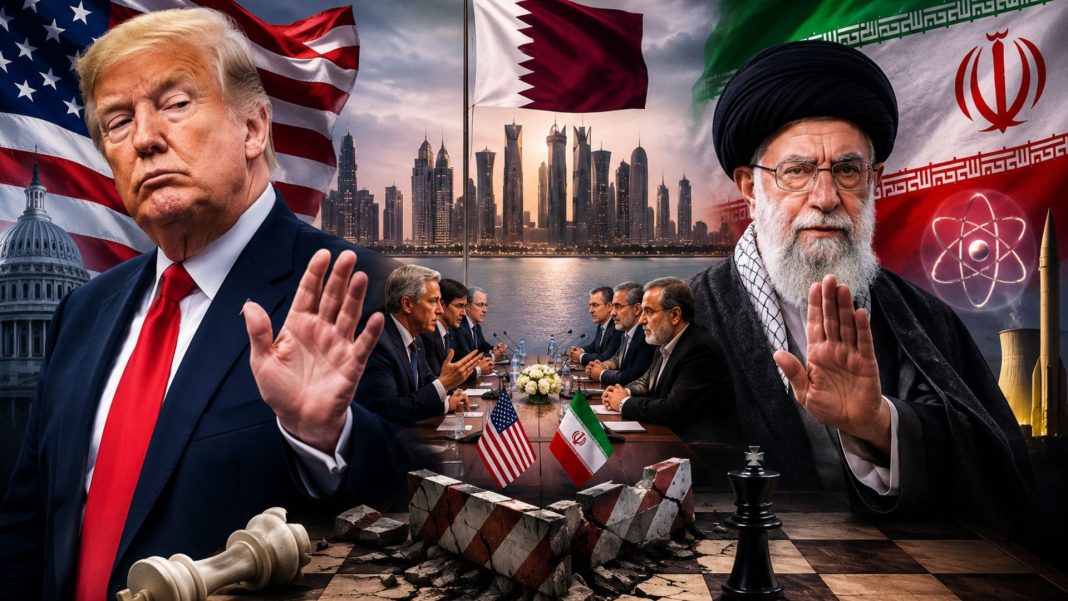

The Doha Deadlock: A high-stakes diplomatic face-off is unfolding in Doha, Qatar, exposing deep rifts between Washington and Tehran. While U.S. President Donald Trump announced that an American delegation has headed to Doha for critical talks, Iran’s Foreign Ministry has fiercely downplayed the event.
Tehran explicitly states that negotiations for a “final agreement” have not begun, insisting that Washington must first fulfill the strict preconditions of the preliminary Memorandum of Understanding (MoU) signed on June 17.
The text-based layout below highlights the conflicting positions of both nations as they enter this crucial diplomatic phase:
The U.S. Angle: The primary goal is to permanently end Iran’s nuclear program. Washington holds the stance that it maintains a strong military upper hand, viewing the Doha talks as something that “may or may not” be important.
The Iranian Angle: The primary goal is achieving total sanction relief. Tehran’s stance is firm: no final deal will be negotiated until the June 17 MoU prerequisites are fully implemented by the U.S.
Two Sides, Two Drastically Different Agendas
The Doha Deadlock: The current updates reveal a classic geopolitical chess match where both nations are spinning the narrative to maintain leverage.
- Iran’s Leverage Play: No Preconditions, No Progress
Iranian Foreign Ministry Spokesperson Esmaeil Baghaei has set a rigid boundary. Tehran is treating the Doha visit as an “expert-level delegation” meeting primarily focused on technicalities, rather than a political summit for a final peace deal.
By making the implementation of the June 17 MoU a prerequisite, Iran is shifting the burden of performance entirely onto the United States.
Tehran’s non-negotiable checklist before “Final Deal” talks begin:
A complete halt to military hostilities on all regional fronts.
The immediate lifting of the U.S. naval blockade on Iranian ports.
A reduction of the U.S. military footprint surrounding Iran.
The full restoration and reopening of the strategic Strait of Hormuz.
The removal of crippling sanctions targeting Iranian oil exports.
The unfreezing and release of billions in Iranian assets stuck in Qatar and other international banking hubs.
The Analytical Angle: Iran is suffering immense economic pain from frozen assets and restricted oil exports. By playing hardball, Tehran is signaling that it will not negotiate its nuclear sovereignty under the immediate threat of a naval blockade.
- Trump’s “Art of the Deal” Posturing: Strategic Ambiguity
Speaking to reporters at the White House, President Donald Trump displayed his signature style of diplomatic nonchalance, stating the Doha talks “might be important, or they might not be.” By keeping his statements vague, Trump prevents Iran from claiming a diplomatic victory before the meetings even start. However, underneath the casual rhetoric lies a firm, unyielding objective.
Trump explicitly clarified that the United States is operating from a position of absolute military dominance and that the ultimate, non-negotiable American goal remains the permanent termination of Iran’s nuclear program.
The Strategic Battleground: What’s Really At Stake?
The Doha Deadlock: The conflict boils down to a fundamental disagreement over objectives and leverage across key areas:
Primary Objectives: The United States wants to dismantle Tehran’s nuclear infrastructure permanently. Conversely, Iran’s core focus is securing absolute relief from Western economic sanctions.
Military Leverage: The U.S. relies heavily on its massive naval and air presence in the Persian Gulf. Meanwhile, Iran holds the counter-threat of shutting down global energy corridors like the Strait of Hormuz.
Financial Friction: Washington is using frozen assets, specifically billions of dollars held in Qatar, as a bargaining chip. Iran demands the immediate release of these funds to stabilize its struggling domestic economy.
The true flashpoint remains the Strait of Hormuz and the frozen funds in Qatar. For the U.S., releasing the funds is viewed as a reward for Iranian compliance. For Iran, receiving the funds is a prerequisite for even sitting at the table.
This chicken-and-egg dilemma threatens to derail the fragile diplomatic channel before it can even mature into a comprehensive treaty.
The Core Issue
The Doha talks are hanging by a thread. While the departure of the U.S. delegation proves that neither side wants an all-out war, the public rhetoric shows a massive trust deficit. Trump is relying on maximum military and economic pressure to force a nuclear surrender, while Iran is refusing to budge until its economic lifelines are restored.
Until the fundamental conditions of the June 17 MoU are mutually settled, any talk of a “final peace deal” remains premature.
Also Read : BLOODSHED IN NORTHERN GERMANY: 5 DEAD IN SHOCKING TOWN CENTRE SHOOTING