



Middle East Conflict Escalates: Tensions in the Middle East reached a dangerous breaking point on Tuesday, September 8, following a dramatic escalation between American forces and Iranian-backed groups.
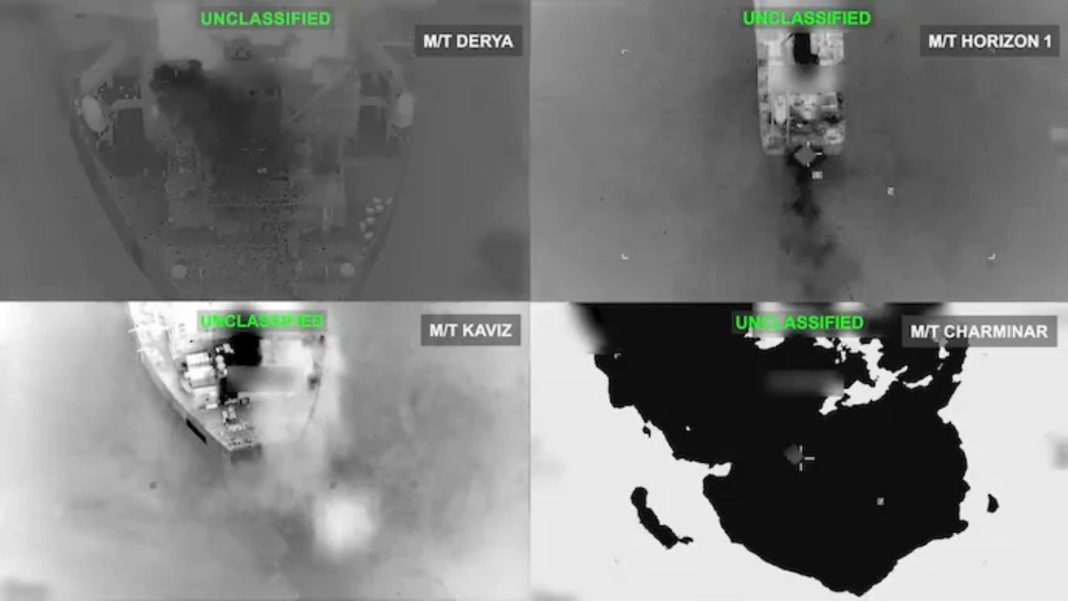
The United States military launched targeted strikes against five oil tankers linked to Tehran, triggering a swift and aggressive response from Iran.
Within hours, Iranian forces fired a salvo of 20 ballistic missiles toward a US military base in Jordan, threatening to push the region into a broader conflict.
US Central Command Strikes Shadow Fleet in Gulf Operations
Middle East Conflict Escalates: According to statements released by US Central Command (CENTCOM), American forces struck four oil tankers in the Gulf of Oman and a fifth vessel anchored near Kharg Island. Washington defended the pre-dawn naval operations, asserting that these vessels formed a critical core of an illicit multi-billion-dollar “shadow network.”
Military officials confirmed that crew members were warned to evacuate the vessels before munitions were deployed.
“These vessels directly finance the Islamic Revolutionary Guard Corps (IRGC) and fund destabilizing operations across the region. Every strike targets the financial backbone of state-sponsored terror.” — US Military Spokesperson
US Strikes Sparked by Repeated Attacks on American Navy Ships
Middle East Conflict Escalates: CENTCOM revealed that the precision strikes were executed in direct response to provocations at sea. Iranian forces reportedly launched two separate ballistic missile attacks against a US Navy warship over a 48-hour period.
Target: A US Navy guided-missile warship patrolling international waters.
Outcome: Onboard defensive systems successfully intercepted all incoming Iranian missiles.
Casualties & Damage: Zero American casualties; the warship remains operational and on active patrol.
Precedent: This follows an earlier September 5 engagement where US forces hit three Iranian tankers after attempts to target an American aircraft carrier group.
Retaliation in the Sky: Jordan Intercepts Iranian Missile Barrage
Middle East Conflict Escalates: Hours after the tanker strikes, air defense sirens sounded across Jordan as Tehran launched 20 ballistic missiles toward a key US military installment hosted in the country.
The Jordanian Armed Forces confirmed that their localized air defense batteries reacted instantly, neutralizing 18 incoming missiles mid-air. The remaining two missiles missed their targets, impacting uninhabited desert terrain without causing loss of life or infrastructure damage.
Conflict Spills Into Strait of Hormuz: Ships Targeted, Submarine Drone Captured
The maritime standoff escalated rapidly across critical shipping lanes. Following the strike on its tankers, Iran claimed responsibility for targeting 10 commercial and naval vessels in the Strait of Hormuz, including two American-flagged ships and eight commercial oil tankers. Tehran argued that these vessels violated restricted maritime corridors.
In a parallel development, the IRGC announced the capture of an advanced US autonomous underwater vehicle (AUV) operating in the region. Images released by Iranian state media show an unmanned vessel closely matching the design and dimensions of the ‘Dive-LD’ submarine drone built by US defense contractor Anduril, an asset capable of deep-sea surveillance and autonomous operations.
Washington Issues Direct Warning as Regional Ports Face Threat
In a press conference held during a diplomatic visit to Colombia, US Secretary of State Marco Rubio issued an unequivocal warning to Tehran regarding freedom of navigation and the safety of American personnel.
“If Iran continues to attack US naval vessels, it will continue to lose its tankers. America will not hesitate to protect its sailors and interests in international waters.” Marco Rubio, US Secretary of State
Undeterred by Washington’s stern stance, the IRGC expanded its warnings to maritime traffic anchored near Kuwait and Bahrain. Tehran issued immediate evacuation demands to foreign crews stationed on ships in these ports, warning that any vessel tied to American supply lines, whether at anchor or docked, remains a legitimate target for military strikes.
Why Kharg Island Holds the Key to Global Energy Markets
The inclusion of Kharg Island in recent strikes has sent shockwaves through international energy markets. Situated in the Persian Gulf, Kharg Island serves as Iran’s primary crude oil export terminal and handles over 90 percent of the nation’s total crude exports.
Crude oil is transported directly from mainland pipelines to deep-water tanker berths on the island before being shipped to international buyers. Because of this strategic concentration, any expanding military action around Kharg Island poses an immediate threat to global energy supply lines and could trigger sharp spikes in international oil prices.
High-Stakes Standoff Threatens Regional Stability
With missile strikes hitting targets from the Gulf of Oman to Jordanian airspace, the confrontation between Washington and Tehran has evolved from proxy skirmishes into direct military exchanges. As both nations double down on retaliatory measures, military analysts warn that even a minor miscalculation could ignite an uncontrollable war across the Middle East.
Also Read : UN Map Controversy: How a New World Map Sparked Fresh Border Tensions for India