


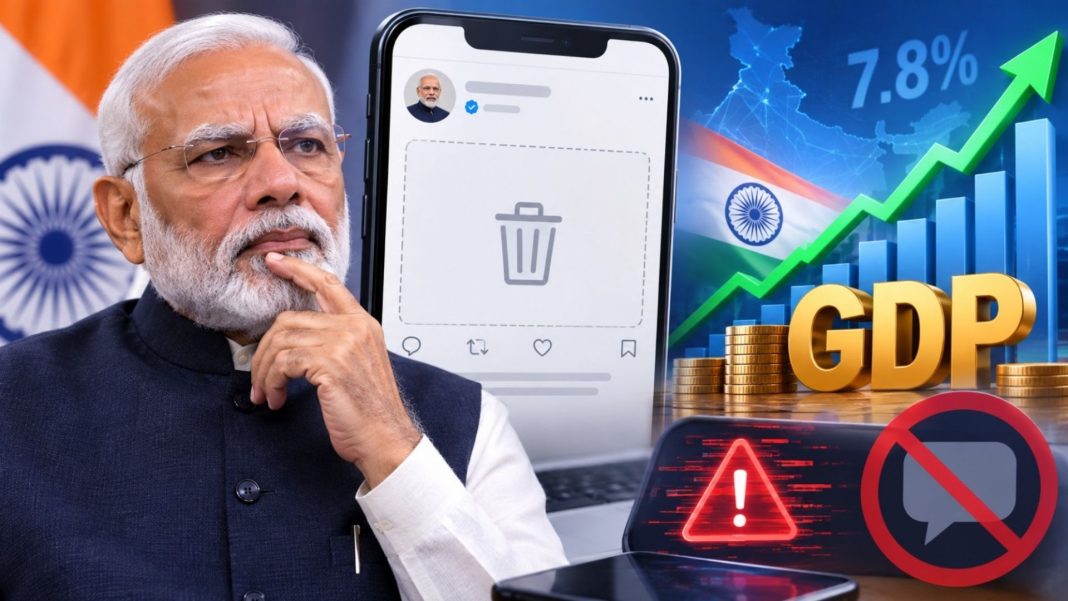

Modi’s 7.8% GDP Post Vanishes: Amidst a fragile global landscape plagued by persistent geopolitical friction and economic volatility, India’s economic narrative has once again broken the mold.
Official data for the first quarter of financial year 2026-27 pegged India’s real GDP growth at an impressive 7.8%, comfortably outperforming market forecasts and Reserve Bank of India projections.
Yet, as Prime Minister Narendra Modi and thousands of digital creators took to platforms like X (formerly Twitter) to amplify this milestone, something bizarre happened.
Key posts celebrating the country’s economic resilience mysteriously vanished from his profile, engagement metrics plummeted, and the overarching digital reach of the news hit an artificial ceiling.
For many, this immediately triggered a familiar sense of déjà vu. Is this recurrent digital phenomenon a series of harmless server glitches, or is it a calculated instance of algorithmic suppression targeting India’s leadership and success?
The Pattern of Disappearing Success: Coincidence or Design?
Modi’s 7.8% GDP Post Vanishes: When top-tier state announcements or massive macroeconomic milestones suddenly face reduced visibility, dismissing them as routine technical bugs becomes hard to digest. The recent disappearance of Prime Minister Modi’s high-profile posts celebrating the 7.8% Q1 GDP surge is not an isolated incident in the digital history of Indian discourse.
Observers and digital rights advocates have long pointed out a recurring trend: whenever narrative-shifting positive news about India’s growth, infrastructural leaps, or its leadership breaks out, major social media algorithms experience a selective blackout.
We saw a similar digital friction during past high-stakes movements, where outreach videos featuring Prime Minister Modi connecting directly with the country’s youth abruptly vanished from feeds.
That particular incident forced severe regulatory pushback, resulting in the Indian government summoning tech giants like Meta and forcing public apologies over sudden content removals. When multi-billion-dollar corporations face state warnings over “technical anomalies,” it stretches credulity to label subsequent occurrences as mere server caching issues.
Decoding the Tech Giants: Technical Glitch vs. Digital Censorship
Modi’s 7.8% GDP Post Vanishes: To understand why platforms like Meta and X behave this way when leaders like Modi share monumental national achievements, one has to look at how modern recommendation engines operate. These platforms run on complex, opaque machine-learning models designed to maximize user engagement, often by prioritizing sensationalism, polarization, or controversy over organic state victories.
The Velocity Threshold and Automated Triggers: When a particular economic or political keyword surrounding Prime Minister Modi spikes globally within minutes, automated safety filters and bot-detection protocols can mistake organic viral surges for coordinated manipulation. If the algorithm misinterprets a massive national celebration as an inorganic bot attack, it throttles the reach automatically.
Geopolitical and Ideological Gatekeeping: Silicon Valley platforms operate under specific institutional biases and regulatory pressures from Western jurisdictions.
An emerging superpower charting an independent economic course under strong leadership, defying global slowdowns and international conflicts, often disrupts the established narrative of global decline. When domestic achievements spearheaded by figures like Modi challenge this worldview, systemic algorithmic dampening quietly steps in.
The Plausible Deniability of “Glitch Culture”: By hiding behind terms like “server load,” “shadow-banning errors,” or “ephemeral cache updates,” global tech firms maintain plausible deniability. They can suppress high-impact national narratives without ever being held directly accountable for political censorship.
The Real Cost of Silent Information Control
The implications of this invisible censorship go far beyond a few missing likes or retweets on a leader’s timeline. When global digital infrastructures selectively mute the economic realities of a nation housing 1.4 billion people, they distort the global information ecosystem.
India’s 7.8% growth print, achieved under steady fiscal management despite severe external headwinds like regional conflicts and high energy costs, is a matter of profound macroeconomic significance.
It signals robust domestic consumption, strong secondary-sector expansion, and a thriving digital economy. Denying this data visibility on public squares under the guise of technical glitches denies the global South a narrative of resilience and self-reliance.
As algorithmic black-boxes tighten their grip on digital speech, the question is no longer whether tech platforms possess the power to alter political and economic realities online. The real question is how long sovereign nations will tolerate digital gatekeepers rewriting the visibility of their hard-earned success stories.
Also Read : Tragedy in Hardoi: Class 8 Student Dies After Teacher Allegedly Twists Arm Over Exam Dispute