


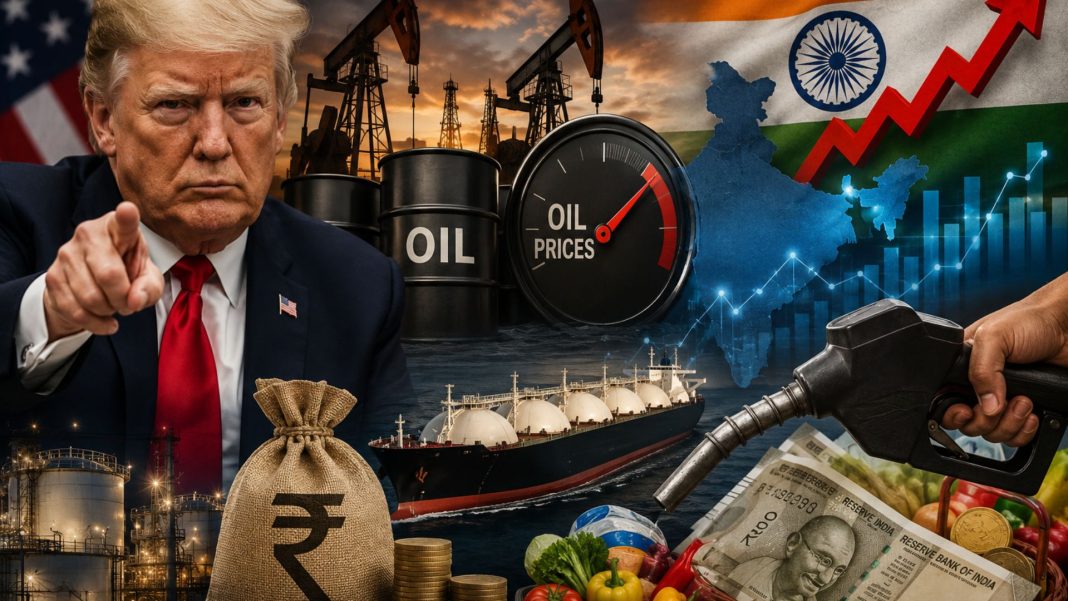

Trump’s Ultimatum to Big Oil: When United States President Donald Trump wages a high-stakes war against American oil giants to force retail fuel prices down, the financial ripples are felt thousands of miles away, in the corridors of New Delhi, the financial hubs of Mumbai, and at every local petrol pump across India.
In a recent, highly publicized statement on his social media platform, Truth Social, President Trump issued a fierce ultimatum to major energy companies. He pointed out that while global crude oil prices have fallen sharply to around $68 per barrel, retail pumps have failed to pass these savings onto everyday consumers.
Terming this disparity “illegal price gouging,” Trump demanded that retail prices be slashed to approximately $2.50 per gallon, warning of severe legal and regulatory consequences via the US Department of Justice (DOJ) if compliance is delayed.
As an economy that imports over 85% of its total crude oil requirements, India is incredibly sensitive to these global energy shifts. Trump’s aggressive push to artificially accelerate price cuts and anchor global oil dynamics near the $68 mark acts as a massive macroeconomic win for India.
Here is a comprehensive analysis of exactly how this developing US energy crisis will impact the Indian economy, corporate sectors, government policies, and your personal finances.
Direct Relief at Indian Petrol Pumps
Trump’s Ultimatum to Big Oil: The most immediate question for any Indian citizen is simple: Will petrol and diesel prices finally drop here? The answer is a resounding yes.
Indian State-Run Oil Marketing Companies (OMCs), such as Indian Oil Corporation Limited (IOCL), Bharat Petroleum Corporation Limited (BPCL), and Hindustan Petroleum Corporation Limited (HPCL), adjust or freeze retail fuel prices based on international benchmarks, primarily the price of Brent crude.
For the past several quarters, these companies have maintained elevated retail prices to recover from previous losses incurred during the peak of the Russia-Ukraine and Middle East conflicts. However, with Trump publicly shaming American oil companies for hoarding profits, a global precedent is being set.
As global crude trends lower, Indian OMCs will face immense public, media, and political pressure to pass these windfall savings onto the public. Energy analysts estimate that if international crude stabilizes between $65 and $70 per barrel due to Washington’s pressure, Indian consumers can expect a direct retail price cut of ₹3 to ₹5 per litre on petrol and diesel, offering long-awaited relief to commuters and transport operators.
A Massive Shield Against Indian Inflation
Trump’s Ultimatum to Big Oil: High oil prices are the single biggest enemy of the Indian middle class because oil is the lifeblood of logistics. India relies heavily on road transport to move goods across its vast geography. When diesel prices remain high, the cost of transporting vegetables, milk, medicines, textiles, and electronic goods skyrockets, leading to stubborn retail inflation (Consumer Price Index).
With the US administration successfully forcing global crude prices down, India receives a structural shield against inflation:
Cheaper Logistics and Supply Chains: Freight operators and commercial trucking companies will experience lower operational expenditures. This reduction directly translates to lower wholesale and retail prices for daily essential commodities.
Lower Fast-Moving Consumer Goods (FMCG) Manufacturing Costs: Companies that manufacture soaps, detergents, cosmetics, plastics, and packaged foods rely heavily on crude oil derivatives for packaging and raw materials. Lower oil prices reduce their input costs, preventing corporate price hikes and driving consumer affordability.
Room for Interest Rate Cuts: Persistent inflation has forced the Reserve Bank of India (BBI) to maintain high repo rates, keeping bank loans expensive. A sustained drop in oil-induced inflation gives the RBI the necessary economic comfort to consider cutting interest rates, which could eventually make your home loans, personal loans, and car EMIs significantly cheaper.
The Indian Rupee Gets Stronger as the Import Bill Shrinks
India spends a staggering amount of foreign exchange reserves, predominantly US Dollars, just to purchase the oil required to keep its economy running. This creates a perpetual demand for dollars, which naturally puts pressure on the value of the Indian Rupee (INR).
Economic data consistently demonstrates a clear fiscal domino effect for the Indian economy when oil prices drop:
Global Crude Drops to $68: The raw cost of energy imports plummets globally.
India’s Import Bill Shrinks: Economists estimate that for every $10 drop in the price of a crude oil barrel, India saves roughly $12 billion to $15 billion annually.
Current Account Deficit (CAD) Narrows: The gap between what India imports and what it exports shrinks dramatically, strengthening the nation’s balance sheet.
Less Outflow of US Dollars: Because the government and private refiners need fewer dollars to buy the same volume of oil, the demand for the US Dollar decreases domestically.
Indian Rupee (INR) Strengthens: The relative value of the Rupee rises, stabilizing the currency against global shocks.
A stronger Rupee provides a secondary economic benefit: it makes other critical imports, such as electronic components, semiconductor chips, solar panels, defense equipment, and heavy machinery, significantly cheaper for Indian businesses, boosting overall industrial productivity.
Green Signal for the Indian Stock Market (Nifty & Sensex)
Trump’s crackdown on oil behaves like premium fuel for a major bull run across the Indian stock exchanges (BSE and NSE). Several high-performing corporate sectors in India are directly tied to the cost of crude oil. When crude prices fall, these industries experience an immediate expansion in profit margins, attracting massive domestic and Foreign Institutional Investor (FII) capital.
Aviation Sector
Fuel, specifically Aviation Turbine Fuel (ATF), accounts for nearly 35% to 40% of an airline’s total operating expenses. With crude prices cooling down significantly, airlines like InterGlobe Aviation (IndiGo) and others will experience a drastic reduction in costs. This increases corporate profitability and allows airlines to offer competitive ticket pricing, boosting passenger traffic.
Paint and Tyre Manufacturers
The paint and tyre industries are highly dependent on petrochemicals. Companies like Asian Paints, Berger Paints, Kansai Nerolac, MRF, and Apollo Tyres use crude oil derivatives as primary raw ingredients for manufacturing paints, solvents, synthetic rubber, and carbon black. Lower crude oil prices immediately reduce their cost of goods sold (COGS), resulting in bumper quarterly earnings reports.
Automobile and Logistics Sectors
Cheaper fuel prices dramatically improve consumer sentiment. When petrol and diesel prices drop, consumers are far more likely to purchase passenger cars, SUVs, and commercial vehicles. Simultaneously, logistics giants and delivery startups see their fleet management costs decline, directly improving their bottom-line performance.
The Geopolitical Advantage for New Delhi
President Trump’s aggressive stance against high oil prices creates a highly competitive global buyers’ market. Over the last few years, India has masterfully navigated geopolitical tensions by purchasing heavily discounted crude oil from Russia, saving billions of dollars in the process.
With the US President actively utilizing regulatory threats to drive traditional global benchmarks like West Texas Intermediate (WTI) and Brent crude down to the $68 range, traditional oil-exporting cartels like OPEC (Organization of the Petroleum Exporting Countries) lose their pricing power.
This gives New Delhi immense geopolitical leverage. Indian oil diplomats can now negotiate even deeper discounts and more favorable payment terms with Russia, Middle Eastern giants like Saudi Arabia and the UAE, and African oil-producing nations. It ensures long-term energy security for the country while keeping the domestic economy well-insulated from foreign supply shocks.
Summary of Impact Metrics for India
Fiscal Savings: Potential savings of over $15 billion annually if crude remains under $70.
Retail Fuel Prices: Anticipated reduction of ₹3 to ₹5 per litre at domestic fuel pumps.
Corporate India Profitability: Upward margin revisions for Aviation, Paint, Tyres, Chemicals, and Logistics sectors.
Currency Stability: Reduced pressure on the INR, allowing for more stable foreign trade.
While Donald Trump’s strict warning to “Big Oil” is fundamentally aimed at pleasing the American voter and tackling domestic discontent, its most prominent structural beneficiary is the Indian economy. For a fast-growing nation like India, a global crude price of $68 is an absolute sweet spot.
It curbs domestic inflation, protects national foreign exchange reserves, boosts corporate profitability, and strengthens the national currency. Most importantly, it paves a clear path for much-needed financial relief for the common Indian citizen right at the local fuel pump.