



MIDEAST MELTDOWN: The West Asian skies rained fire for a consecutive sixth night as the United States military launched its most devastating wave of precision air strikes across southern Iran.
While previous attacks focused heavily on decapitating military command structures, the latest multi-city offensive shifted focus entirely toward crippling maritime choke points and economic lifelines.
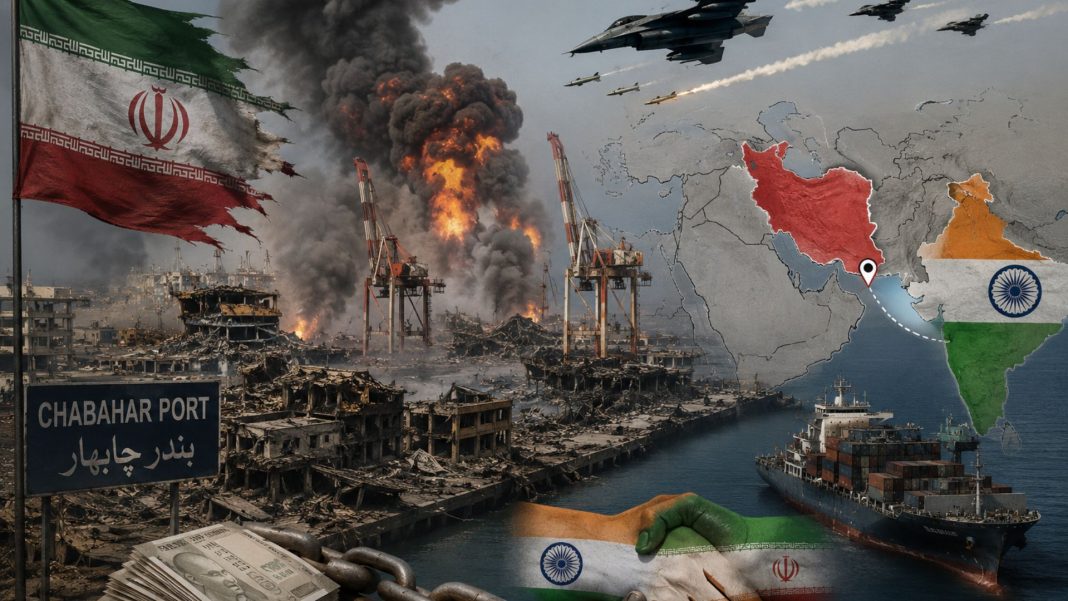
The geopolitical shockwave has hit New Delhi directly, with the crown jewel of India’s regional diplomacy, the strategically vital Chabahar Port, finding itself directly in the line of fire.
Control Tower Collapses: Hegseth Releases Visual Proof of Port Destruction
MIDEAST MELTDOWN: The intensity of the offensive was brought to light when U.S. Defense Secretary Pete Hegseth made public a highly sensitive operational image.
The photograph captures the complete collapse and obliteration of the Marine Traffic Control Tower at Chabahar’s Shahid Kalantari sector following a direct U.S. Central Command (CENTCOM) strike.
The Pentagon asserts the tower was part of an active maritime surveillance network deployed by Iran’s Islamic Revolutionary Guard Corps (IRGC) to track and intercept commercial shipping in the Gulf of Oman.
However, the physical destruction of this facility threatens to halt the broader operational capabilities of the entire port cluster.
Ministry of External Affairs on High Alert: ‘Beheshti Terminal Safe, But Danger Imminent’
MIDEAST MELTDOWN: India’s Ministry of External Affairs (MEA) immediately moved into damage-control mode, issuing a tense clarification regarding India’s specific investments.
Official spokesperson Randhir Jaiswal confirmed that the Shahid Beheshti Cargo Terminal, which is operated directly by India under a landmark 10-year bilateral agreement, has not sustained physical structural damage.
Despite the temporary safety of the concrete berths, India’s broader economic and human stakes are bleeding out:
The Financial Abyss: India spent over ₹400 crore annually in recent years to build the terminal. Analysts fear that if the port’s foundational infrastructure is permanently disabled, India’s cumulative programmatic layout of over ₹1,000 crore (including transit corridors) could be rendered entirely unviable.
Stranded at Sea: At least 7 Indian-flagged commercial vessels remain completely trapped in the escalating crossfire within the broader Persian Gulf, unable to navigate safe exit routes due to targeted maritime blockades.
Human Cost: The MEA grimly acknowledged that the raging conflict has already claimed the lives of 14 Indian nationals caught in the regional crossfire.
The Economic Siege: Choking ‘Bandar Abbas’ via Infrastructure Decapitation
MIDEAST MELTDOWN: Military analysts point out that Washington has executed a highly calculated shift in its war doctrine. Rather than engaging in a ground war or launching an immediate direct assault on downtown Tehran, the U.S. air campaign is systematically choking out Bandar Abbas, Iran’s premier commercial port responsible for the vast majority of its sea trade.
Transit Infrastructure: 6 Major bridges pulverized in Hormozgan to stop domestic freight.
Logistics Hubs: Bandar Abbas Railway Station destroyed, freezing cargo movement.
Aviation Systems: Iranshahr Tactical Airport neutralized to prevent aerial reinforcement.
Energy Distribution: Grid infrastructure struck, causing immediate rolling blackouts nationwide.
By isolating Bandar Abbas from the rest of the domestic mainland, the U.S. is inducing an internal economic standstill. The destruction of primary power stations has forced the Iranian Energy Ministry to issue desperate appeals to its citizens to conserve remaining electricity as the national grid teeters on the edge of total collapse.
Total Theater Warfare: Kuwait’s Water Supply Smashed as Rockets Rain on Qatar and Bahrain
Iran has made it clear that it will not absorb these blows in silence. Moving into a doctrine of total regional asymmetry, the IRGC launched a barrage of precision missiles targeting crucial Western-aligned infrastructure across the Gulf states.
Critical Hit: An Iranian missile strike successfully breached the air defense shield of Kuwait, severely damaging a primary desalination water plant. This single facility supplies nearly 90% of Kuwait’s domestic drinking water, triggering an immediate internal humanitarian emergency.
Simultaneously, air sirens have continuously wailed across Qatar, Bahrain, and Iraq as Iranian regional proxies drop short-range ballistic missiles onto forward U.S. military logistics bases and radar hubs.
The Shadow of Hormuz: Why Global Oil Markets Face a Catastrophic Spike
Global energy analysts are raising red flags over the geographic spread of the aerial combat. The war is now hovering dangerously close to the Strait of Hormuz, the world’s most crucial maritime oil artery, through which one-fifth of global petroleum consumption passes.
If Iran follows through on its threat to fully blockade the Strait, or if U.S. forces completely seal the channel to counter Iranian fast-attack crafts, energy supplies will instantly freeze.
Market experts project that a prolonged conflict in Hormuz will send crude oil prices skyrocketing past record highs, causing retail petrol and diesel prices to surge exponentially worldwide, triggering a brutal wave of global inflation.
For India, the stakes could not be higher. New Delhi finds its massive financial investments frozen, its alternative trade route to Central Asia severed, and its domestic economy exposed to the volatile shocks of a burning Middle East.